Finding a refrigerant leak quickly can reduce equipment downtime, prevent repeat service calls, and help protect system performance. The right detector should match the leak types, working conditions, and diagnostic tools you use most often.
This roundup compares ultrasonic instruments with heated-diode and infrared options, covering professional kits, compact service tools, and versatile detectors for HVAC, automotive, and industrial applications.
Best 10 Ultrasonic Refrigerant Leak Detectors Picks for 2026
Professional Ultrasonic Kit
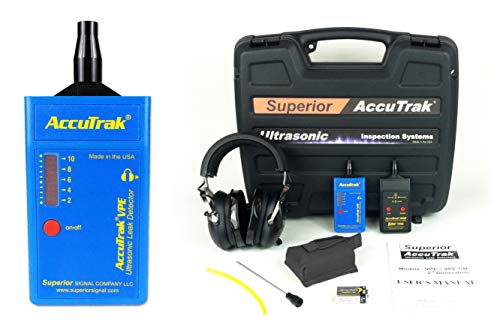
- Natural 0–4 kHz sound conversion
- 10-element visual bar graph
- Probe, waveguide, headphones, battery, and case included
Best For: Professional HVACR inspections requiring a complete ultrasonic kit
Refrigerant-Specific Sensitivity

- Low through super sensitivity settings
- Automatic and manual zero modes
- Detects CFC, HCFC, HFC, HFO, A2L, and blended refrigerants
Best For: HVACR professionals needing adjustable refrigerant detection
Essential Ultrasonic Kit

- Natural sound conversion for leak identification
- 10-element visual bar graph
- Headset, battery, and hard case included
Best For: Straightforward ultrasonic leak checks with essential accessories
Ultra-Sensitive Heated Diode

- Detects leaks smaller than 0.03 oz./yr.
- Backlit LCD, LED tip, and audible beep
- A2L compatible with 17-inch flexible probe
Best For: Detailed HVACR leak searches in tight or hard-to-reach spaces
Best Overall Ultrasonic Detector

- Detects pressure and vacuum leaks across all gases
- Headphones and laser pointer aid precise locating
- Includes case, extension probe, and batteries
Best For: Versatile HVAC and industrial leak troubleshooting
Best Refrigerant-Focused Alternative
Fieldpiece DR82 Infrared Leak Detector

- Detects leaks smaller than 0.03 oz/yr
- Supports major refrigerants and blends
- Rechargeable battery lasts over 10 hours
Best For: Sensitive HVACR refrigerant leak detection
Best Accessory Bundle

- Adds metal contact probe and transmitter
- Detects pressure and vacuum leaks in all gases
- Includes headphones, extension probe, case, and batteries
Best For: Expanded ultrasonic inspection and troubleshooting
Best Overall Refrigerant Detector
Fieldpiece SRL2(K7) Advanced Leak Detector

- Detects CFCs, HFCs, HCFCs, and blends
- Sealed sensor resists oil and moisture triggers
- Starts in under 30 seconds; up to 8-hour battery life
Best For: HVAC professionals needing fast, contamination-resistant refrigerant detection
Best Heavy-Duty Pick
AccuTrak VPE-GN Pro-Plus Ultrasonic Leak Detector

- Adjustable sensitivity and peak-hold display
- Resists wind and high leaked-gas concentrations
- Includes probes, waveguide, headphones, and sound generator
Best For: Professional inspections in noisy, confined, or hard-to-reach areas
Best Portable Multi-Use Detector
38-42kHz Ultrasonic Leak Finder

- Detects air, gas, and water leaks
- Adjustable sensitivity with LED and audio alerts
- Includes headphones, case, and 9V battery
Best For: Portable HVAC, automotive, and industrial leak inspections
Professional Ultrasonic Kit – AccuTrak VPE PRO
For technicians comparing ultrasonic refrigerant leak detectors, the AccuTrak VPE PRO emphasizes audible leak detection with a natural-sound conversion system and a visual bar graph. Its included touch probe, waveguide, headphones, battery, and large case make it a well-equipped professional kit.
Best For: Professional HVACR users who want both audio and visual ultrasonic feedback.
Pros:
- Natural sound conversion from 0 Hz to 4 kHz helps users hear and distinguish leaks.
- 10-element bar graph provides a quick visual indication of leak presence.
- Includes a touch probe, waveguide, noise-blocking headphones, battery, and carrying case.
- Supports operation in environments with up to 95% humidity.
Cons:
- The complete kit is relatively heavy at about 5.3 pounds.
- Its 17 x 7 x 14-inch listed dimensions may be less convenient for compact tool storage.
The VPE PRO is a strong choice when a complete ultrasonic inspection setup matters more than minimum size or weight.
Refrigerant-Specific Sensitivity – INFICON D-TEK 3
The INFICON D-TEK 3 is a refrigerant-focused option among ultrasonic refrigerant leak detectors, offering low, medium, high, and super sensitivity settings. Automatic and manual zero modes help support different inspection approaches, while broad refrigerant compatibility covers common CFC, HCFC, HFC, HFO, A2L, and blended refrigerants.
Best For: HVACR technicians who need adjustable sensitivity and broad refrigerant coverage.
Pros:
- Four sensitivity settings accommodate different leak-search conditions.
- Automatic and manual zero modes provide operational flexibility.
- Detects CFCs, HCFCs, HFCs, HFOs, A2Ls, and blends.
- Includes a lithium-ion battery, filters, wall charger, and rugged carrying case.
Cons:
- It is designed as a refrigerant leak detector rather than a general-purpose ultrasonic detector.
- The listed 5 x 12 x 16-inch dimensions may require dedicated storage space.
Choose the D-TEK 3 if refrigerant compatibility and selectable sensitivity are higher priorities than a basic, single-mode tool.
Essential Ultrasonic Kit – AccuTrak VPE BASIC
The AccuTrak VPE BASIC offers a simpler entry point for shoppers evaluating ultrasonic refrigerant leak detectors. It uses natural sound conversion to help users hear leaks and includes a 10-element visual bar graph, headset, battery, and hard case without the expanded accessories of the PRO kit.
Best For: Users who want a straightforward ultrasonic detector with essential accessories.
Pros:
- Natural sound conversion makes leaks easier to hear and distinguish.
- 10-element bar graph adds visual confirmation of leak presence.
- Includes a headset, battery, and hard case.
Cons:
- The BASIC kit does not list the PRO kit’s touch probe, waveguide, or noise-blocking headphones.
- Supplied notes provide limited technical specifications beyond the core audio and visual outputs.
The VPE BASIC is a practical fit for buyers who want core ultrasonic detection functions and a compact accessory package without stepping up to the professional kit.
Ultra-Sensitive Heated Diode – Fieldpiece DR58
The Fieldpiece DR58 takes a heated-diode approach to refrigerant leak detection, with sensitivity down to leaks smaller than 0.03 oz./yr. Its backlit LCD, LED tip, audible beep, flexible 17-inch probe, and A2L compatibility make it suited to detailed HVACR troubleshooting in tight spaces.
Best For: HVACR technicians who need high sensitivity, clear leak-intensity feedback, and reach around confined components.
Pros:
- Heated diode sensor detects leaks smaller than 0.03 oz./yr., according to the supplied notes.
- Compatible with HFC, CFC, HCFC, HFO, H2N2 tracer gas, blends, and A2L applications.
- Backlit LCD, LED tip, and beep provide multiple leak indicators.
- 17-inch flexible probe, 18-hour rechargeable battery, and replaceable filter tips support field use.
Cons:
- The heated diode sensor is listed with an approximately 300-hour sensor life.
- Filter tips require replacement over time, although five replacement tips are included.
The DR58 is a compelling choice for technicians who prioritize sensitivity and probe reach, especially when working with newer A2L systems or difficult-to-access areas.
Best Overall Ultrasonic Detector – INFICON Whisper
The INFICON Whisper is a versatile choice for technicians comparing ultrasonic refrigerant leak detectors and broader gas-leak tools. It detects pressure and vacuum leaks across gases, uses headphones for clearer listening, and remains useful in noisy environments.
Best For: HVAC, maintenance, and industrial technicians who need one ultrasonic tool for multiple leak-detection applications.
Pros:
- Detects pressure and vacuum leaks for all gases, including pressurized nitrogen.
- Headphones and a laser pointer help identify leaks in noisy or hard-to-access areas.
- Also supports applications such as electrical arcing and malfunctioning steam traps.
- Includes a rugged carrying case, rubber extension probe, and two D-cell batteries.
Cons:
- Uses two D-cell alkaline batteries rather than a rechargeable power system.
- Its broader industrial focus may be more than needed for refrigerant-only work.
Choose the Whisper when versatility matters as much as refrigerant leak detection. Its ultrasonic design, laser pointer, and included accessories make it a practical all-around troubleshooting instrument.
Best Refrigerant-Focused Alternative – Fieldpiece DR82 Infrared Leak Detector
The Fieldpiece DR82 is a refrigerant-focused option for shoppers comparing ultrasonic refrigerant leak detectors with other sensing technologies. Its infrared sensor detects leaks smaller than 0.03 oz/yr, supports common refrigerant families and blends, and provides audible, visual, and LCD feedback.
Best For: HVACR technicians who prioritize sensitive refrigerant detection, clear leak-size indication, and a lightweight rechargeable tool.
Pros:
- Detects leaks smaller than 0.03 oz/yr and is rated 20 times more sensitive than bubbles.
- Works with CFC, HCFC, HFC, HFO, and blended refrigerants.
- Backlit LCD, LED tip, and beeps make leak intensity and location easier to interpret.
- Offers a 17-inch probe, USB-C battery life of more than 10 hours, and replaceable filter tips.
Cons:
- It uses non-dispersive infrared sensing rather than ultrasonic technology.
- Its stated upper temperature rating is 104°F.
Although it is not an ultrasonic detector, the DR82 is a strong alternative when the priority is dedicated refrigerant sensitivity. Its durable IP54-rated design and long sensor life suit regular HVACR service work.
Best Accessory Bundle – INFICON Whisper Kit
INFICON Whisper with Accessory Kit, Enhanced Ultrasonic Leak Detector, 711-203-G1,Off-White
Check Price On AmazonThe INFICON Whisper with Accessory Kit expands the standard ultrasonic refrigerant leak detector setup with a metal contact probe and a battery-powered transmitter. It detects pressure and vacuum leaks for all gases, while headphones and a laser pointer help technicians work around background noise.
Best For: Technicians who want an ultrasonic leak detector with extra probing options and a transmitter for broader troubleshooting tasks.
Pros:
- Includes premium headphones, a metal contact probe, rubber extension probe, and transmitter.
- Detects pressure and vacuum leaks for all gases, including pressurized nitrogen.
- Designed for use in noisy environments with laser-assisted pinpointing.
- Comes with two D-cell batteries and a rugged carrying case.
Cons:
- The accessory-rich kit may be unnecessary for users who need only basic leak detection.
- It relies on two D-cell alkaline batteries.
This kit is the better Whisper configuration for technicians who will use both contact and airborne ultrasonic inspection methods. The included transmitter and probes add flexibility for maintenance work beyond refrigerant systems.
Best Overall Refrigerant Detector – Fieldpiece SRL2(K7) Advanced Leak Detector
The Fieldpiece SRL2(K7) is a practical choice for technicians who want a fast refrigerant leak detector with a sealed sensor. It detects changes in refrigerant levels across CFCs, HFCs, HCFCs, and blends, while resisting false triggers from oil, moisture, and contaminated environments.
Best For: HVAC professionals who need quick, reliable refrigerant detection in demanding service conditions.
Pros:
- Triggers on CFCs, HFCs, HCFCs, and blends.
- Sealed sensor does not trigger on oil or moisture like other detector types.
- Ready to use in less than 30 seconds and runs for up to 8 hours.
- Includes a blow-molded case for transport and storage.
Cons:
- Focused on refrigerant detection rather than broader air, water, or mechanical leak applications.
- Requires a lithium-ion battery.
Its rapid startup, contamination resistance, and broad refrigerant compatibility make the SRL2(K7) a strong all-around option for routine HVAC leak checks.
Best Heavy-Duty Pick – AccuTrak VPE-GN Pro-Plus Ultrasonic Leak Detector
The AccuTrak VPE-GN Pro-Plus is a versatile ultrasonic leak detector kit for locating leaks in challenging environments. Adjustable sensitivity, a peak-hold display, noise-canceling headphones, and a gooseneck-style setup help users investigate hard-to-reach areas without relying on visibility alone.
Best For: Professional maintenance teams checking refrigerant, gas, air, seals, gaskets, and other leak sources in noisy or confined spaces.
Pros:
- Adjustable sensitivity supports different inspection conditions.
- Not affected by wind or high concentrations of leaked gas or refrigerant.
- Includes noise-blocking headphones, touch probe, waveguide, and sound generator.
- Peak-hold display and over-range audio alarm provide added feedback.
Cons:
- The larger professional kit may be more equipment than occasional users need.
- Its broad accessory package may require additional setup and storage space.
With multiple probes and sound-isolation accessories, this kit is designed for users who need more flexibility than a basic handheld ultrasonic detector provides.
Best Portable Multi-Use Detector – 38-42kHz Ultrasonic Leak Finder
This portable ultrasonic leak detector uses a 38-42kHz frequency range to identify turbulence created by escaping air, gas, or water. Adjustable sensitivity, LED and audio alerts, a built-in frequency filter, and proximity sensing make it a flexible option for HVAC, automotive, and industrial inspections.
Best For: Users who want one compact kit for refrigerant-related HVAC checks plus air, gas, water, valve, pipe, and pressurized-system inspections.
Pros:
- Supports detection across air, gas, and water systems.
- Adjustable sensitivity and proximity sensing help pinpoint leak sources.
- Built-in frequency filtering helps reduce ambient noise interference.
- Includes noise-canceling headphones, storage case, and 9V battery.
Cons:
- Its supplied notes describe general ultrasonic leak detection rather than refrigerant-specific sensing.
- Uses a 9V battery, so replacement batteries may be needed for extended work.
- The lightweight design may offer fewer specialized accessories than a professional kit.
For buyers prioritizing portability and broad system coverage, this detector combines straightforward controls with useful visual and audio feedback in a compact package.
How We Picked the Best Ultrasonic Refrigerant Leak Detectors
We evaluated these detectors by looking at detection technology, sensitivity, usability, included accessories, portability, and suitability for real-world service work. Ultrasonic models can help identify the sound produced by escaping gas, while heated-diode and infrared detectors offer alternative approaches for locating refrigerant leaks. Because no single tool is ideal for every job, the selection includes both dedicated ultrasonic instruments and complementary electronic leak sniffers.
We also considered practical details such as headphones or headsets for noisy environments, probe design, display readability, battery operation, carrying cases, and whether a kit is ready for professional use out of the box.
Quick Comparison
- Best for a complete professional kit: Choose a package with a detector, probe, headset, battery, and protective case.
- Best for general HVAC service: Look for adjustable sensitivity, clear alerts, and a comfortable handheld design.
- Best for noisy workplaces: An ultrasonic detector with a headset and directional probe can make pinpointing easier.
- Best for refrigerant-specific sniffing: Heated-diode or infrared models may be preferable when you need electronic refrigerant sensing rather than acoustic detection.
- Best for occasional use: A basic kit can provide useful leak-finding capability without the cost or accessories of a premium package.
Key Buying Factors for Ultrasonic Refrigerant Leak Detectors
Detection Method and Sensitivity
Ultrasonic detectors listen for high-frequency turbulence created by escaping gas. They can be useful when systems are pressurized and when visual or bubble testing is impractical. Heated-diode and infrared detectors sense refrigerant more directly, so compare the technology with the refrigerants and service procedures you use.
Probe, Headset, and Controls
A touch probe or gooseneck extension can help reach valves, fittings, coils, and confined compartments. A headset improves clarity around compressors and fans. Adjustable sensitivity and simple controls are valuable because excessive background noise can create confusing readings.
Display, Alerts, and Working Environment
Backlit screens, audible alerts, visual indicators, and vibration feedback make a detector easier to use in dark mechanical rooms or bright outdoor conditions. Consider whether you need a directional acoustic tool, a large display, or a refrigerant concentration readout.
Power, Durability, and Kit Contents
Check battery type, expected runtime, charging options, warranty coverage, and replacement accessories. A hard case protects the instrument in a service vehicle, while a complete kit may cost more initially but reduce the need for additional purchases.
Who Should Buy Which Ultrasonic Refrigerant Leak Detectors?
HVAC technicians and refrigeration contractors should prioritize sensitivity, directional probing, headset compatibility, and durable construction. A professional ultrasonic kit or a high-end electronic sniffer is usually the most efficient choice for frequent service calls.
Automotive technicians may prefer a compact refrigerant detector that is easy to maneuver around engine bays and air-conditioning components. A model with clear alerts and a lightweight body is especially practical.
Facilities teams and industrial maintenance departments should consider versatility, battery life, protective storage, and the ability to investigate compressed-air or mechanical noise as well as refrigerant systems.
DIY users and occasional inspectors can save money with a basic ultrasonic kit, provided they understand that readings depend on system pressure, access, and surrounding noise. For difficult or safety-critical leaks, professional diagnosis remains the better choice.