Finding a refrigerant leak quickly can save service time, protect system performance, and reduce repeat callbacks. The best heated diode refrigerant leak detectors combine dependable sensitivity with practical controls, durable probes, and clear alarms.
This roundup compares 10 options for HVAC technicians, maintenance teams, and serious DIY users. Use the guide below to match sensor performance, power requirements, ergonomics, and portability to the work you actually do.
Best 10 Heated Diode Refrigerant Leak Detectors Picks for 2026
Top-Sensitivity Pick

- Detects leaks below 0.03 oz./year
- Works across many refrigerants and blends
- 18-hour USB-rechargeable battery
Best For: Technicians needing maximum sensitivity and clear leak indicators
Professional Corded Choice

- Corded electric operation
- Audible alarm
- Built for HVAC applications
Best For: Bench or shop environments with convenient electrical access
Long-Shift Workhorse

- Approximately 15-hour rechargeable battery
- 30-second startup
- Protective filter and manual or automatic zeroing
Best For: Mobile technicians handling extended leak-detection shifts
Rugged General-Purpose Pick
- A2L certified heated diode sensor
- Detects CFC, HCFC, HFC, and HFO refrigerants
- Includes case, filters, and D-cell batteries
Best For: Routine service work requiring broad refrigerant coverage
Reliable Field Detection
hilmor LDHD250 Heated Diode Leak Detector

- Detects halogenated refrigerants including R410 and R22
- Audible, visual, and LCD leak indications
- Flexible probe for difficult-to-reach spaces
Best For: HVAC technicians needing broad refrigerant compatibility
Adjustable Sensitivity
Inficon D-TEK 3 Refrigerant Leak Detector

- Four sensitivity settings from Low to Super
- Automatic and manual zero modes
- Detects CFCs, HCFCs, HFCs, HFOs, blends, and A2Ls
Best For: Technicians working across mixed refrigerant systems
Published Detection Rates
Extech RD350 Heated Diode Leak Detector

- Detects down to 3 g/yr on high for several refrigerants
- Three sensitivity levels help manage background signals
- 400 mm flexible probe with LED and audible alerts
Best For: Technicians wanting stated leak-rate performance
Long-Life Professional Pick
- Broad HFC, HCFC, blend, and HFO coverage
- Sensor life tested beyond 10 years
- Bar graph, sound, vibration, and adjustable sensitivity
Best For: Technicians prioritizing durability and broad refrigerant compatibility
High-Sensitivity Heated Diode Choice
HVAC Leak Detector with 0.05 oz/yr Sensitivity

- Heated diode sensitivity rated to 0.05 oz/yr
- Nine-level LED leak display and three sensitivity settings
- 20-inch flexible, replaceable probe
Best For: Detailed leak tracing across automotive, home, and commercial systems
Rechargeable Display Pick
SENSYX SFD200 Refrigerant Leak Detector

- Up to 24 hours from a 2500mAh rechargeable battery
- Live ppm reading with color LCD and bar graph
- Broad CFC, HCFC, HFC, and HFO detection
Best For: Mobile technicians wanting USB-C charging and numeric leak feedback
Top-Sensitivity Pick – Fieldpiece DR58
For technicians who want highly sensitive heated diode refrigerant leak detectors, the Fieldpiece DR58 combines micro-leak detection with a readable backlit display and practical jobsite features. It detects leaks smaller than 0.03 oz./year and works with a broad range of refrigerants, including A2L applications.
Best For: HVACR professionals prioritizing very high sensitivity, easy leak indication, and cordless use.
Pros:
- Detects leaks smaller than 0.03 oz./year.
- Works with HFC, CFC, HCFC, HFO, H2N2 tracer gas, and blends.
- Backlit LCD, LED tip, and audible beep help indicate leak intensity and location.
- USB-rechargeable battery provides up to 18 hours of use; five replacement filter tips are included.
Cons:
- Its 3-pound weight may be more than some compact detectors.
- The sensor is rated for approximately 300 hours, so replacement planning is part of ownership.
The DR58 is a strong choice when sensitivity and clear feedback matter most. Its long battery runtime, flexible 17-inch probe, and moisture- and oil-resistant design add useful durability for regular HVACR work.
Professional Corded Choice – Bacharach H-10 Pro
The Bacharach H-10 Pro is a straightforward option among heated diode refrigerant leak detectors for users who prefer a corded electric HVAC tool. Its supplied specifications identify it as an industrial refrigerant leak detector with an audible alarm.
Best For: Workshop or service-bench use where corded operation and an audible alarm are suitable.
Pros:
- Uses a corded electric power source.
- Provides an audible alarm.
- Designed for HVAC applications under the Bacharach brand.
Cons:
- Corded operation is less convenient for remote or hard-to-reach service calls.
- The supplied notes do not specify sensitivity, refrigerant coverage, battery operation, or included accessories.
The H-10 Pro may fit technicians who already work near dependable electrical power and want a focused Bacharach solution. Buyers needing portable operation or detailed sensitivity specifications should compare those requirements before choosing.
Long-Shift Workhorse – Fieldpiece SRL8
The Fieldpiece SRL8 is a practical choice among heated diode refrigerant leak detectors for technicians who need dependable operation through long service days. It detects CFCs, HFCs, HCFCs, and blends, while its filter system helps protect the sensor from moisture and oil contamination.
Best For: Mobile HVAC technicians who value long battery life, fast startup, and a replaceable protective filter system.
Pros:
- Runs for about 15 hours on a rechargeable, user-replaceable battery.
- Can operate while connected to a wall or vehicle charger.
- Starts in approximately 30 seconds.
- Automatic or manual zeroing helps locate leaks, and the filter helps shield the sensor from moisture and oil.
Cons:
- The notes state that sensitivity varies by refrigerant.
- At about 3.12 pounds, it is not an especially lightweight tool.
The SRL8 emphasizes field practicality rather than a display-heavy interface. Its quick warm-up, charging flexibility, and sensor-protection system make it well suited to repeated leak-hunting work across a full schedule.
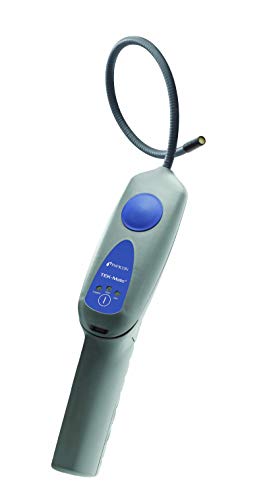
Rugged General-Purpose Pick – Inficon TEK-Mate 705
The Inficon 705-202-G1, also known as the TEK-Mate, offers a proven heated diode design for routine refrigerant service. It detects CFCs, HCFCs, HFCs, and HFOs, is A2L certified, and uses automatic background adjustment to help limit false alarms from soap solutions.
Best For: Technicians seeking a rugged, broadly compatible detector with simple battery operation and included transport protection.
Pros:
- Detects CFC, HCFC, HFC, and HFO refrigerants.
- A2L certified heated diode sensor has a stated sensitivity of 0.25 oz./year.
- Automatic background adjustment helps prevent false alarms from soap solutions.
- Includes D-cell alkaline batteries, filters, and a rugged carrying case.
Cons:
- Battery life is listed at approximately 8 hours.
- The sensor life is rated at 100 hours.
- It uses two D-cell alkaline batteries rather than a rechargeable battery system.
The Inficon TEK-Mate is a sensible general-purpose option when broad refrigerant coverage and straightforward operation matter. Its carrying case and US technician support add reassurance, while the shorter battery and sensor ratings are worth factoring into ongoing service costs.
Reliable Field Detection – hilmor LDHD250 Heated Diode Leak Detector
The hilmor LDHD250 is a practical choice for technicians comparing heated diode refrigerant leak detectors. It is designed to detect halogenated refrigerants, including R410 and R22, while combining audible and visual alerts with an LCD display.
Best For: HVAC technicians who need broad refrigerant compatibility and a flexible probe for hard-to-reach areas.
Pros:
- Works with all halogenated refrigerants listed by the manufacturer, including R410 and R22.
- Provides both audible and visual leak notifications.
- LCD screen is designed for easy reading.
- Flexible probe helps access confined areas.
Cons:
- At 5.6 pounds, it is relatively heavy for a handheld detector.
- The supplied notes do not specify sensitivity levels or a stated detection rate.
The LDHD250 emphasizes straightforward operation, visibility, and access. Its flexible probe and broad halogenated-refrigerant coverage make it a versatile option, though buyers wanting published sensitivity specifications may prefer a model with more detailed performance data.
Adjustable Sensitivity – Inficon D-TEK 3 Refrigerant Leak Detector
The Inficon D-TEK 3 gives buyers comparing heated diode refrigerant leak detectors four sensitivity settings, from Low through Super. Its automatic and manual zero modes help tailor operation, while refrigerant coverage includes CFCs, HCFCs, HFCs, HFOs, blends, and A2Ls.
Best For: Technicians who want adjustable sensitivity, zeroing options, and coverage across older, current, and A2L refrigerants.
Pros:
- Offers Low, Medium, High, and Super sensitivity settings.
- Includes both automatic and manual zero modes.
- Detects CFCs, HCFCs, HFCs, HFOs, blends, and A2Ls.
- Rugged carrying case is included.
Cons:
- The supplied notes do not state a specific leak-rate detection threshold.
- Product dimensions are listed as 5 by 12 by 16 inches, which may be bulky for storage depending on how they are measured.
The D-TEK 3 stands out for control and refrigerant coverage rather than a published detection-rate figure. Its adjustable settings and zero modes can be useful when working across varied equipment, and the included case supports transport between jobs.
Published Detection Rates – Extech RD350 Heated Diode Leak Detector
The Extech RD350 is a useful reference point when comparing heated diode refrigerant leak detectors because it publishes detection performance for several refrigerants. It offers three sensitivity levels, a 400 mm flexible probe, and both visual and variable audible indications.
Best For: HVAC and refrigeration technicians who want stated leak-rate performance and a probe suited to coils and compressor areas.
Pros:
- Detects 3 g/yr on high for several listed refrigerants, including R-32, R-134a, R-404A, R-407C, R-410A, and HFO-1234yf.
- Three sensitivity levels help reduce background chasing.
- 400 mm flexible probe reaches behind compressors and into condenser coils.
- Tri-color LED and variable audible alarm provide matching leak-level feedback.
Cons:
- Requires a stated 45-second warm-up before operation.
- High-setting performance is listed as 4 g/yr for R-22 rather than 3 g/yr.
- The supplied refrigerant list is narrower than a general claim covering every blend.
The RD350 is compelling for buyers who value concrete detection figures and practical probe reach. Its sensitivity controls can help distinguish background from a target leak, while the warm-up requirement is a small tradeoff for its heated diode design.
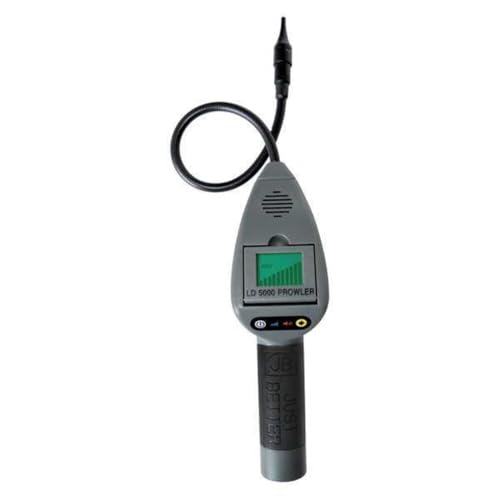
Long-Life Professional Pick – JB Industries LD-5000 Prowler
For technicians who want dependable performance from heated diode refrigerant leak detectors, the JB Industries LD-5000 Prowler emphasizes accuracy, durable sensing, and flexible alarm controls. Its electrochemical sensor is designed for HFC, HCFC, blended, and newer HFO refrigerants, with sensitivity adjustable across three levels.
Best For: HVAC professionals seeking a long-lasting detector for a broad range of refrigerants.
Pros:
- Detects HFC, HCFC, blended, and HFO refrigerants.
- Sensor life is tested to exceed 10 years and is designed not to diminish with use.
- Combines a leak bar graph, audible alert, and handle vibration.
- Offers high, medium, and low sensitivity settings, plus a mute option.
Cons:
- Battery-powered rather than rechargeable.
- At 3.3 pounds, it may feel heavier than compact handheld options.
The LD-5000 stands out when sensor longevity and broad refrigerant coverage matter more than minimizing weight. Its multiple alert methods and programmable sensitivity make it a practical choice for repeated service work.
High-Sensitivity Heated Diode Choice – HVAC Leak Detector with 0.05 oz/yr Sensitivity
This heated diode refrigerant leak detector is built for pinpointing small leaks, with stated sensitivity down to 0.05 oz/yr and an inhalation-style design intended to speed response. A 20-inch flexible probe, nine-level display, and three sensitivity settings make it adaptable for automotive, residential, and commercial service.
Best For: Users who want high sensitivity, visual leak-level feedback, and a flexible probe for hard-to-reach areas.
Pros:
- Heated diode sensor is rated to detect leaks as small as 0.05 oz/yr in stationary conditions.
- Supports CFC, HCFC, HFC, HFO, blended refrigerants, and halon gases.
- Nine-stage LED leak display provides an at-a-glance indication of severity.
- Includes manual and automatic zeroing, mute control, and a replaceable probe.
Cons:
- The supplied notes do not specify battery type or runtime.
- High sensitivity may require careful zeroing and use of lower settings to limit environmental interference.
With its strong stated sensitivity and detailed display, this model is a compelling option for locating subtle leaks. The flexible 20-inch probe also adds reach when fittings or equipment are difficult to access.
Rechargeable Display Pick – SENSYX SFD200 Refrigerant Leak Detector
The SENSYX SFD200 offers a rechargeable alternative to traditional heated diode refrigerant leak detectors, using a Japanese-made metal-oxide semiconductor sensor and a live ppm display. Its two sensitivity levels support broad sweeps and closer pinpointing, while the built-in battery is rated for up to 24 hours of continuous operation.
Best For: Service users who value long battery life, USB-C charging, and live concentration readings.
Pros:
- 2500mAh rechargeable battery provides up to 24 hours of continuous work.
- USB-C charging eliminates the need for disposable batteries.
- Detects a broad range of CFC, HCFC, HFC, and HFO refrigerants.
- Color LCD shows live ppm concentration and a bar graph, with muteable audio.
Cons:
- Its metal-oxide sensor requires several hours of initial operation to reach full sensitivity.
- Only high and low sensitivity settings are provided.
- It is an inspection tool, not a substitute for a listed gas alarm.
The SFD200 is particularly convenient for mobile technicians who want rechargeable power and numeric feedback instead of relying only on beeps. Proper warm-up and careful scanning technique are important for consistent results.
How We Picked the Best Heated Diode Refrigerant Leak Detectors
We focused on detectors designed for identifying halogenated refrigerants in air-conditioning, refrigeration, and heat-pump systems. The comparison considers stated sensitivity, heated-diode sensor design, alarm behavior, probe reach, display readability, battery or charging convenience, and the tool’s suitability for professional field use.
We also looked for meaningful differences among established HVAC instruments, including ruggedness, replacement sensor availability, calibration or reset features, and ease of use in cramped or noisy mechanical spaces. Product specifications can vary by version, so confirm the manufacturer’s current details before purchase.
Quick Comparison
| What to compare | Why it matters |
|---|---|
| Sensitivity | Determines how effectively the tool can locate small leaks. |
| Sensor and probe design | Affects response time, reach, and performance around fittings. |
| Power source | Rechargeable or replaceable batteries suit different service routines. |
| Display and alarms | Clear visual and audible feedback helps in bright or noisy areas. |
| Durability | Important for daily service calls, transport, and job-site handling. |
Key Buying Factors for Heated Diode Refrigerant Leak Detectors
Sensitivity and Refrigerant Compatibility
Choose a detector with sensitivity appropriate to your work. Higher sensitivity can help locate very small leaks, but it also makes correct technique more important. Check that the tool supports the refrigerants used in your systems and follow the manufacturer’s recommended warm-up, reset, and testing procedures.
Probe Reach and Response Control
A flexible probe makes it easier to inspect evaporator areas, line sets, service ports, and concealed connections. Adjustable sensitivity or automatic background compensation is useful when working around residual refrigerant or contaminated air.
Feedback, Controls, and Ergonomics
Look for a readable screen, a useful bar graph or numerical indication, and alarms that can be heard without becoming distracting. One-handed controls, a balanced housing, and a light probe can reduce fatigue during long diagnostic sessions.
Battery Life and Maintenance
Review expected operating time, charging arrangements, battery replacement, sensor replacement, and filter requirements. A detector that is easy to maintain is more likely to be ready when a service call begins.
Who Should Buy Which Heated Diode Refrigerant Leak Detectors?
Professional HVAC technicians: Prioritize reliable sensitivity, rugged construction, clear alarms, and readily available replacement parts. A well-supported instrument is usually worth more than the lowest purchase price.
Refrigeration and maintenance teams: Favor models with strong battery endurance, repeatable operation, and a probe that can reach crowded equipment compartments.
Occasional service users: A simpler, portable detector may be sufficient if it covers your refrigerants and offers clear status feedback. Verify calibration and sensor availability before choosing a budget model.
Whichever option you select, use a confirmed leak-detection procedure: inspect likely joints and components methodically, control background contamination, and verify suspected leaks with an approved follow-up method before completing repairs.