A solar charge controller with Bluetooth makes it easier to monitor charging data, battery status, and system performance from your phone. The right model can also improve energy harvest and protect your batteries from overcharging.
These 10 options cover efficient MPPT controllers, budget-friendly PWM designs, multiple amperage ratings, and systems ranging from compact 12V setups to larger 24V installations.
Best 10 Solar Charge Controller with Bluetooth Picks for 2026
Compact Smart Choice

- Compact 53% smaller design
- Built-in Bluetooth and LCD monitoring
- Supports 12V/24V batteries and expandable arrays
Best For: Space-constrained RV and off-grid installations
App-Focused Premium Option

- Bluetooth-enabled VictronConnect app
- MPPT charging with partial-shade optimization
- Supports synchronized multi-controller setups
Best For: Small systems needing detailed app control
Budget-Friendly PWM Pick

- 30A PWM charging for 12V/24V systems
- Built-in Bluetooth and LCD
- Dual USB outputs for device charging
Best For: Basic off-grid setups with monitoring and USB needs
Best High-Capacity MPPT

- 50A MPPT charging for larger systems
- Bluetooth app with history and configuration
- Supports synchronized multi-controller setups
Best For: Larger 12V/24V solar installations
Best for Everyday Use
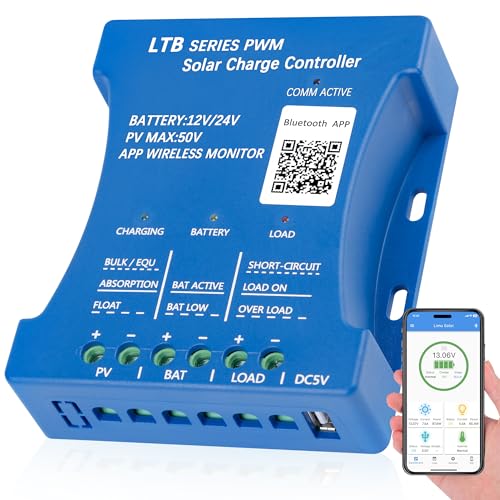
- App control with seven load modes
- Auto-matches 12V/24V systems
- USB output and broad battery compatibility
Best For: Flexible small to mid-sized solar systems
Best Compact MPPT

- Compact MPPT controller for 12V/24V systems
- Bluetooth monitoring through VictronConnect
- Includes history, alarms, and configuration tools
Best For: Lower-power solar setups with limited space
Compact High-Capacity Pick

- Built-in Bluetooth and LCD monitoring
- Supports 12V/24V systems up to 900W
- Compact design with parallel expansion
Best For: Compact RV, van, boat, and cabin solar systems
Proven 20A Monitoring Choice

- Bluetooth module and LCD included
- Up to 99% MPPT tracking efficiency
- Adds load terminals with timer controls
Best For: Smaller 12V/24V solar systems
Feature-Rich 30A Alternative

- Built-in Bluetooth, LCD, and LED indicators
- Supports LiFePO4 and lead-acid batteries
- Handles up to 900W on 24V systems
Best For: RV and off-grid users wanting flexible 30A charging
Compact Smart Choice – Renogy Rover 2 20A MPPT
If you need a solar charge controller with bluetooth for a compact 12V or 24V off-grid setup, the Renogy Rover 2 combines MPPT charging, built-in Bluetooth, and an LCD in a space-saving design. It supports up to 100V PV input and works with several common battery chemistries.
Best For: RVs, vans, campers, boats, and cabins where installation space is limited.
Pros:
- Compact design is 53% smaller than the previous generation.
- Built-in Bluetooth and LCD provide remote and on-device monitoring.
- 99% tracking efficiency with support for arrays up to 300W on 12V or 600W on 24V.
- Supports lithium, AGM, gel, flooded, and user-defined battery profiles.
Cons:
- Limited to 20A of charging current.
- Designed for 12V/24V systems rather than higher-voltage battery banks.
The Rover 2 is a well-rounded choice when footprint, app monitoring, and battery flexibility matter more than maximum current capacity. Its parallel expansion support also leaves room to scale a larger system.
High-Capacity Connected Pick – ECO-WORTHY 60A MPPT
For larger systems seeking a solar charge controller with bluetooth, the ECO-WORTHY 60A MPPT adds WiFi connectivity, automatic system-voltage detection, and support for up to 150V PV input. It also provides configurable load-control modes and battery charging profiles.
Best For: Larger RV, backup, and off-grid systems using 12V, 24V, 36V, or 48V battery configurations.
Pros:
- 60A charging capacity with automatic 12V/24V/36V/48V detection.
- Bluetooth and WiFi enable nearby or long-distance monitoring.
- Supports lead-acid and LiFePO4 batteries with dedicated charging stages.
- Includes three load-control modes and multiple system protections.
Cons:
- Its larger capacity may be unnecessary for small solar arrays.
- The supplied notes mention a Bluetooth/WiFi module, so buyers should verify it is included.
This model stands out for system builders who want substantial charging capacity and flexible remote access. Its 150V PV input and multiple voltage options make it more adaptable than controllers intended only for 12V/24V systems.
App-Focused Premium Option – Victron SmartSolar 15A
The Victron SmartSolar is a compact solar charge controller with bluetooth for 12V and 24V installations. Its MPPT design, VictronConnect app, synchronized multi-controller operation, and configurable load output make it suitable for users who want detailed system control.
Best For: Users who prioritize app-based configuration, performance history, alarms, and coordinated multi-controller charging.
Pros:
- Bluetooth access through the VictronConnect app.
- Provides real-time data, 30-day history, presets, firmware updates, and alarms.
- MPPT tracking is designed to maintain output in partial shade.
- Multiple units can synchronize charging stages.
Cons:
- 15A capacity is suited to smaller systems.
- Its minimal LED display provides less local information than a full LCD.
- Supports 12V/24V systems only.
The SmartSolar 75|15 is a strong fit for a carefully managed small system. Choose it when Victron’s app ecosystem and synchronized expansion are more important than high current capacity or a built-in full-screen display.
Budget-Friendly PWM Pick – ECO-WORTHY 30A Bluetooth
If you want a straightforward solar charge controller with bluetooth for a 12V or 24V setup, this ECO-WORTHY PWM model offers app monitoring, an LCD, three-stage charging, and dual USB outputs. It is designed for lead-acid, gel, and lithium phosphate batteries.
Best For: Smaller home, commercial, industrial, and basic off-grid systems that need convenient monitoring and USB charging.
Pros:
- 30A charging capacity for 12V/24V systems.
- Built-in Bluetooth offers app access up to 98 feet in open-field conditions.
- LCD supports status viewing and parameter configuration.
- Dual USB outputs provide 5V/2.5A maximum charging for mobile devices.
Cons:
- PWM technology is less suited to maximizing solar harvest than MPPT.
- Supports only 12V and 24V systems.
- Requires installation in a flat, well-ventilated location because it heats during operation.
This controller is practical for buyers who want Bluetooth monitoring and useful everyday features without moving to a higher-capacity MPPT unit. Its USB ports are especially convenient for basic mobile-device charging.
Best High-Capacity MPPT – Victron SmartSolar 100V 50A
If you need a solar charge controller with bluetooth for a larger 12V or 24V setup, the Victron Energy SmartSolar MPPT 100/50 combines high current capacity with app-based monitoring. Its MPPT tracking is designed to maximize available solar power, including when panels are partially shaded.
Best For: Larger 12V/24V solar systems where detailed monitoring, configurable settings, and synchronized charging are priorities.
Pros:
- 50A MPPT design helps optimize power harvesting from the panels.
- VictronConnect provides real-time data, 30-day performance history, configuration, firmware updates, and alarms.
- Supports synchronized operation with multiple SmartSolar MPPT controllers.
- Includes configurable load disconnect and low-battery load protection.
Cons:
- It has no built-in display, so monitoring depends on the app.
- Its 100V, 50A capacity may be more than needed for smaller installations.
This is the most capable option in the group for users who want a high-capacity MPPT controller and deeper system visibility through Bluetooth connectivity.
Best for Everyday Use – 30A Bluetooth PWM Controller
This 30A PWM solar charge controller with bluetooth is a practical choice for users who want app-based control without moving to a higher-capacity MPPT model. It automatically matches 12V or 24V systems and supports several battery types, including sealed, gel, flooded, LiFePO4, and lithium batteries.
Best For: Small to mid-sized 12V/24V systems needing Bluetooth monitoring, flexible load scheduling, and a USB charging port.
Pros:
- Mobile app supports real-time monitoring, parameter configuration, battery settings, and load-mode control.
- Offers seven load modes, including light-controlled, timer, manual, and repeat schedules.
- Includes compatibility with multiple battery types and automatic 12V/24V matching.
- Provides a 5V/1.5A USB output and multiple built-in protection functions.
Cons:
- It uses PWM charging rather than MPPT technology.
- Initial battery connection and voltage detection require following the specified setup sequence.
- The supplied notes do not specify a solar input voltage limit.
Choose this model when app control, load scheduling, and battery-type flexibility matter more than the enhanced power harvesting associated with MPPT controllers.
Best Compact MPPT – Victron SmartSolar 75V 10A
For a smaller installation, the Victron Energy SmartSolar 75/10 is a compact solar charge controller with bluetooth that supports 12V and 24V battery systems. Its MPPT technology is designed to improve solar harvesting, while the VictronConnect app adds monitoring and configuration without requiring a built-in screen.
Best For: Compact 12V/24V solar setups that need MPPT performance and Bluetooth-based monitoring in a small controller.
Pros:
- Compact 10A MPPT design suits lower-power solar systems.
- VictronConnect provides real-time information and 30-day performance history.
- App settings include battery presets, firmware updates, and alarms.
- Supports synchronized charging with multiple SmartSolar MPPT controllers.
Cons:
- Its 10A rating is less suitable for larger solar arrays.
- There is no built-in display.
- Its 75V solar input rating provides less headroom than the 100V Victron model listed above.
This is a strong fit when you want Victron’s MPPT and app ecosystem but have a modest system and limited space for equipment.
Compact High-Capacity Pick – Renogy Rover 2 30A MPPT
If you need a solar charge controller with bluetooth for a compact RV, van, boat, or cabin system, the Renogy Rover 2 combines 30A MPPT charging with built-in remote monitoring. Its LCD, 100V PV input, and support for 12V or 24V battery banks make it a flexible choice for expanding off-grid installations.
Best For: Space-constrained 12V/24V systems using up to 450W on 12V or 900W on 24V.
Pros:
- Built-in Bluetooth monitoring requires no external dongle.
- Supports lithium, AGM, gel, flooded, and user-defined battery profiles.
- Compact design is 53% smaller than the previous generation.
- Can be linked in parallel for larger systems.
Cons:
- Its 30A capacity may be limiting for substantially larger arrays.
- The listed plastic construction may not suit buyers seeking a metal enclosure.
The Rover 2 is a strong fit when installation space and remote visibility matter. Its 100V PV limit, thermal design, and parallel expansion option give it useful headroom for a growing off-grid setup.
Proven 20A Monitoring Choice – Renogy Rover 20A MPPT
The Renogy Rover 20A is a practical solar charge controller with bluetooth for smaller 12V or 24V installations. It pairs MPPT charging with an LCD, LED indicators, automatic voltage detection for non-lithium batteries, and a supplied Bluetooth module for remote system information.
Best For: Smaller lead-acid or manually configured lithium systems that need load control and system protection.
Pros:
- MPPT tracking efficiency is rated up to 99%, with peak conversion efficiency up to 98%.
- Includes a Bluetooth module, LCD, and multiple status indicators.
- Offers four-stage charging for lead-acid batteries and lithium charging modes.
- Provides load terminals with consumption monitoring and timer controls.
Cons:
- At 20A, it has less charging capacity than the 30A alternatives here.
- Lithium battery settings require manual configuration.
- Automatic voltage detection applies to non-lithium battery types.
This Rover is a sensible choice for modest solar arrays where detailed status information and load management are useful. Its broad protection features and included Bluetooth module add convenience, though the lower amperage favors smaller systems.
Feature-Rich 30A Alternative – LiTime 30A MPPT Bluetooth
For shoppers comparing a solar charge controller with bluetooth, the LiTime 30A MPPT offers built-in wireless monitoring alongside an LCD and LED indicators. It supports 12V/24V systems, accepts up to 450W on 12V or 900W on 24V, and is configured for both LiFePO4 and lead-acid batteries.
Best For: RV and off-grid users who want 30A charging, onboard Bluetooth, and compatibility with LiFePO4 or lead-acid batteries.
Pros:
- Built-in Bluetooth provides remote control and usage information without an additional module.
- MPPT tracking efficiency is rated at least 99%, with peak conversion efficiency up to 98%.
- Supports LiFePO4 plus sealed, gel, and other listed lead-acid battery types.
- Die-cast aluminum construction is designed to improve heat dissipation.
Cons:
- The listed dimensions and 4.4-pound weight may require more installation space.
- It is rated for 30A, so larger systems may need additional charging capacity.
LiTime’s controller is a well-rounded option for users who want 30A output and built-in Bluetooth without buying a separate module. Its LCD controls, battery flexibility, and protection features make it suited to straightforward RV and off-grid installations.
How We Picked the Best Solar Charge Controller with Bluetooth
We focused on controllers that combine dependable charging regulation with practical wireless monitoring. The selection includes MPPT and PWM models, different current ratings, 12V and 24V compatibility, and support for common battery chemistries such as AGM, gel, flooded lead-acid, and lithium.
We also considered useful hardware features, including LCD displays, Bluetooth or Wi-Fi connectivity, automatic system-voltage detection, configurable charging profiles, temperature protection, and suitability for recreational vehicles, boats, cabins, backup power, and small off-grid installations.
Quick Comparison
| Best For | Recommended Type | What to Look For |
|---|---|---|
| Small 12V systems | 10A–20A MPPT | Low standby draw, Bluetooth app, compact installation |
| Mid-size RV or cabin systems | 20A–30A MPPT | Higher panel capacity, adjustable battery settings, LCD or app monitoring |
| Budget installations | 20A–30A PWM | Simple controls, battery compatibility, proper panel sizing |
| Large 12V or 24V banks | 50A–60A MPPT | Higher PV input limits, heat management, robust terminals and wiring |
Key Buying Factors for a Solar Charge Controller with Bluetooth
MPPT Versus PWM
MPPT controllers generally extract more usable energy from solar panels, particularly in cold, cloudy, or variable conditions. PWM models are usually less expensive and can work well for modest systems where panel voltage closely matches battery voltage.
Current Rating and Solar Capacity
Match the controller’s rated output current to the battery bank and expected solar production. A 20A controller may suit a compact 12V setup, while 30A, 50A, or 60A units are better for larger arrays. Check the manufacturer’s maximum PV voltage and wattage limits before connecting panels.
Battery Compatibility
Confirm that the controller supports your battery chemistry. Lithium batteries often require a dedicated charging profile and may need low-temperature charging protection. Adjustable absorption, float, and cutoff settings are valuable when using less common battery types.
Bluetooth and Display Features
Bluetooth monitoring is useful for checking voltage, current, charging stage, historical performance, and battery status without opening an enclosure. Review app compatibility and connection range, and consider an LCD if you want local readings without a phone.
Installation and Protection
Verify wire-size requirements, terminal capacity, fuse recommendations, reverse-polarity protection, over-temperature safeguards, and enclosure ventilation. Install the controller close to the battery, follow the specified connection order, and keep wiring runs short.
Who Should Buy Which Solar Charge Controller with Bluetooth?
Choose a compact MPPT model for a small RV, van, boat, or backup battery where efficiency and app monitoring matter. A 30A MPPT controller is a flexible choice for many mid-size 12V or 24V systems. Choose a PWM controller when initial cost and straightforward operation are more important than maximum solar harvest.
For larger cabin, workshop, or whole-bank applications, a 50A or 60A MPPT unit provides more headroom, provided the panel array, battery bank, wiring, and fusing are correctly sized. If you want detailed system data and remote checks, prioritize Bluetooth or Wi-Fi connectivity; if multiple users need access or the controller is mounted out of reach, Wi-Fi may be the more convenient option.