Fine dust can linger long after a saw, sander, or router stops running. The right shop air filtration system helps capture airborne particles that ordinary dust collection may miss, keeping your workspace cleaner and reducing the dust that settles on tools and surfaces.
We selected 10 systems covering compact hobby shops, larger woodworking spaces, portable job areas, and demanding cleanup needs. Below, you’ll find the key differences to consider before choosing one for your shop.
Best 10 Shop Air Filtration Systems for Fine Dust Picks for 2026
Compact Shop Pick
WEN 3410 Air Filtration System
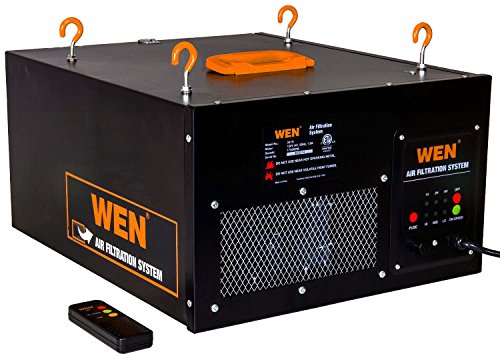
- 1-micron filter plus 5-micron pre-filter
- 300/350/400 CFM airflow settings
- RF remote and programmable timer
Best For: Smaller workshops up to 400 square feet
High-Capacity Workshop Choice
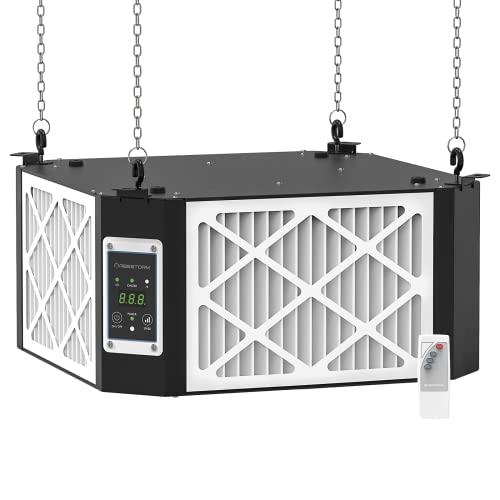
- Up to 1,350 CFM airflow
- MERV-11 filters with 360-degree intake
- Touch and remote controls
Best For: Large woodworking areas up to 1,700 square feet
Professional Fine-Dust Defense
CADPXS Shield-550 Air Scrubber

- Three-stage MERV-10, HEPA, and carbon filtration
- HEPA rating targets 0.3-micrometer particles
- Designed for renovation and restoration use
Best For: Workshops, construction, and restoration environments
Smart Ceiling-Mount Option
DEWALT DWXAF101 Air Filtration System
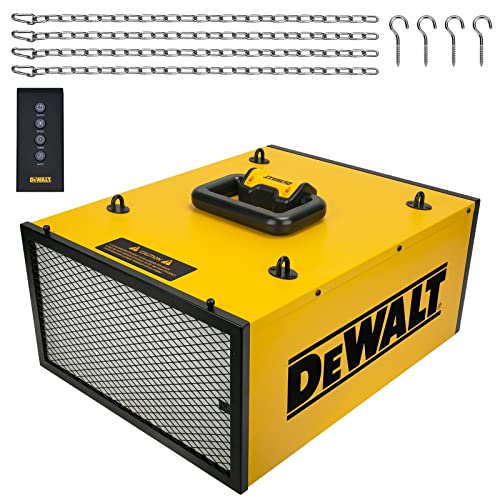
- Washable pre-filter plus H11 HEPA filter
- Automatic mode and four timer settings
- Ceiling-mount design saves floor space
Best For: Woodworking shops needing automated overhead filtration
Best Overall
JET AFS-1000C Air Filtration System

- Two-stage filtration for 5- and 1-micron particles
- Automatic air-quality sensor with six speeds
- Remote control and 16-hour timer
Best For: Automated overhead filtration in woodworking shops
Most Versatile

- Ceiling, wheeled, or benchtop installation
- Two-stage filtration down to 1 micron
- 1025 CFM maximum airflow with remote
Best For: Flexible garage and workshop dust control
Best Compact Option
FJ225-2 Portable HEPA Air Filter

- Compact portable benchtop design
- 850-1050 CFM airflow settings
- 99.5% filtration claim for 0.3-micron particles
Best For: Localized filtration at a woodworking bench
Compact HEPA Pick
RIKON 62-450 Air Filtration System

- Certified HEPA filtration with 1-micron retention
- 250, 350, and 450 CFM speed settings
- Designed for rooms up to 400 square feet
Best For: Smaller workshops needing remote-controlled HEPA air filtration
Large-Shop Coverage

- 1,100 CFM airflow for areas up to 1,100 square feet
- Two-stage replaceable filtration
- RF remote and one- to 12-hour timer
Best For: Large shops and garages needing high airflow
Filter-Set Value
POWERTEC AF4001C 400 CFM System

- Includes four replacement filters
- 5-micron outer and 1-micron inner filtration
- Remote timer and ceiling-mount hardware included
Best For: Woodworkers wanting spare filters with a moderate-airflow system
Compact Shop Pick – WEN 3410 Air Filtration System
The WEN 3410 is a practical entry-level option for shoppers comparing shop air filtration systems for fine dust in a workshop or garage up to 400 square feet. Its 1-micron filter, 5-micron pre-filter, three airflow settings, and remote-controlled timer provide straightforward overhead air cleaning.
Best For: Smaller workshops that need simple, remote-controlled filtration and a programmable shutoff.
Pros:
- Uses a 1-micron filter alongside a replaceable 5-micron pre-filter.
- Offers 300, 350, and 400 CFM airflow settings.
- RF remote works from up to 26 feet and does not require direct line of sight.
- Programmable timer automatically shuts the unit off.
Cons:
- Its stated coverage is limited to rooms up to 400 square feet.
- Maximum airflow is lower than the larger systems in this roundup.
- Noise is listed at 50 to 60 dB.
Choose the WEN when compact coverage and easy controls matter more than high-volume circulation. The replaceable filters and timer make it a convenient fit for routine workshop use.
High-Capacity Workshop Choice – ABESTORM DecDust 1350IG
The ABESTORM DecDust 1350IG is built for shoppers who need shop air filtration systems for fine dust across a larger woodworking area. It combines 1,050–1,350 CFM airflow, 360-degree intake, MERV-11 filters, and touch or remote controls for broad workshop circulation.
Best For: Large woodworking shops, garages, and hobby spaces up to 1,700 square feet.
Pros:
- Provides up to 1,350 CFM airflow and coverage up to 1,700 square feet.
- 360-degree intake system supports air collection from around the unit.
- Includes four replaceable MERV-11 filters that can be cleaned for reuse.
- Offers both panel touch controls and remote operation from up to 27 feet.
Cons:
- Its 60 to 69 dBA noise rating may be noticeable in a quiet shop.
- Filters are expected to be replaced every two to four months, depending on use.
- The built-in ionizer may not appeal to shoppers seeking filtration without ionization.
The ABESTORM stands out for high airflow and wide stated coverage. It is a strong match for active woodworking spaces, provided you are comfortable with its larger footprint and higher operating noise.
Professional Fine-Dust Defense – CADPXS Shield-550 Air Scrubber
The CADPXS Shield-550 is a commercial-style choice for shoppers comparing shop air filtration systems for fine dust, odors, smoke, and renovation debris. Its three-stage setup combines an MERV-10 pre-filter, HEPA filter, and activated carbon filter in a 550 CFM negative-air machine.
Best For: Renovation, restoration, construction, and workshop environments that need HEPA and odor-focused filtration.
Pros:
- Three-stage filtration includes MERV-10, HEPA, and activated carbon filters.
- HEPA filtration is rated to remove 99.97% of particles at or above 0.3 micrometers.
- Activated carbon helps address odors and VOCs from paint, smoke, adhesives, and chemicals.
- ETL and CARB certifications are listed, along with a 10-year limited warranty.
Cons:
- At 550 CFM, it moves less air than the ABESTORM system.
- The 65 dB noise rating may be noticeable during operation.
- Its 33.5-pound, floor-standing design is less space-saving than hanging units.
The Shield-550 is the most filtration-focused option here, especially when odors and fumes accompany fine dust. Its commercial design makes it better suited to demanding cleanup or renovation work than basic everyday circulation.
Smart Ceiling-Mount Option – DEWALT DWXAF101 Air Filtration System
The DEWALT DWXAF101 is a space-saving option for shoppers looking at shop air filtration systems for fine dust in a garage or woodworking shop. It hangs from the ceiling and combines a washable cotton pre-filter with an H11 HEPA filter, four operating modes, automatic air-quality sensing, and timer settings.
Best For: Woodworkers who want overhead installation, automatic operation, and remote-controlled scheduling.
Pros:
- Two-stage filtration uses a washable cotton pre-filter and H11 HEPA filter.
- Four modes include high, medium, low, and automatic air-quality sensing.
- Remote control and 1-, 2-, 4-, and 8-hour timer settings simplify operation.
- Ceiling hooks and chains preserve floor space, while the pre-filter indicator aids maintenance.
Cons:
- Its listed filtration performance is over 95% for 0.3-micrometer particles, below the 99.97% figure specified for the CADPXS HEPA system.
- The 64 dB noise rating may be audible in the workshop.
- Its stated contaminant capability is limited to dust.
The DWXAF101 is a well-rounded choice when installation flexibility and automation are priorities. Its washable pre-filter and replacement indicator can also make routine upkeep more manageable.
Best Overall – JET AFS-1000C Air Filtration System
If you shop air filtration systems for fine dust, the JET AFS-1000C is a strong all-around option for a workshop. Its two-stage filtration captures larger 5-micron particles and smaller 1-micron particles, while the automatic air-quality sensor adjusts among six speeds.
Best For: Woodworkers who want automated operation, remote control, and high-capacity air cleaning in a ceiling-mounted shop system.
Pros:
- Outer filter captures 99% of 5-micron particles, while the inner filter captures 85% of 1-micron particles.
- Automatic sensor adjusts six speeds according to air quality.
- Remote control includes speed adjustment and a 16-hour timer.
- Angled LED display and filter-status indicator simplify monitoring.
Cons:
- At 67 dB on the highest setting, it is not silent.
- Designed primarily for ceiling mounting rather than portable placement.
- Its 33-pound body and 30.13-inch depth require suitable overhead space.
The JET combines useful automation with two-stage particle filtration and a quiet, efficient BLDC motor. It is a practical choice when you want a dedicated overhead system with more than basic fan controls.
Most Versatile – iLIVING AF8000 Air Scrubber
For shoppers comparing air filtration systems for fine dust, the iLIVING AF8000 stands out for its flexible installation. It can hang from the ceiling, roll on wheels, or sit on a benchtop, and its two-stage filter setup handles particles down to 1 micron.
Best For: Garage and workshop users who need a movable or ceiling-mounted air cleaner with 1025 CFM maximum airflow.
Pros:
- Flexible ceiling-hanging, wheeled, and benchtop use.
- Two-stage filtration removes larger particles up to 5 microns and smaller particles up to 1 micron.
- Three speeds deliver up to 1025 CFM of airflow.
- Remote control and built-in timers add operating convenience.
Cons:
- Maximum-speed noise is rated at 70 dB.
- At 68.4 pounds, it is substantially heavier than the JET model.
- The one-year limited component warranty is shorter than some alternatives.
The AF8000 is a practical fit when placement flexibility matters as much as filtration. Its wheeled design makes it easier to move toward active dust-producing work, while ceiling mounting can preserve floor space.
Best Compact Option – FJ225-2 Portable HEPA Air Filter
If you shop air filtration systems for fine dust but need a compact unit, the FJ225-2 offers a portable benchtop approach. Its two selectable airflow settings reach 1050 CFM, and the supplied HEPA carbon filter is specified to stop 99.5% of 0.3-micron particles.
Best For: Benchtop woodworking, carving, turning, mixing, and other tasks where localized portable filtration is useful.
Pros:
- Compact 15.75-by-8.74-by-12.2-inch design with a carrying handle.
- Two airflow settings from 850 to 1050 CFM.
- Filter is specified to stop 99.5% of 0.3-micron particles.
- Rated below 55 dB, making it the quietest listed option by its supplied specifications.
Cons:
- Only two power levels are provided.
- The filter should be replaced approximately every four months.
- Its localized tabletop format may be less convenient for whole-room ceiling filtration.
The FJ225-2 is appealing when portability, compact storage, and fine-particle filtration take priority. Its small footprint makes it easier to position near a work area, though it is not presented as a conventional large-room ceiling unit.
Compact HEPA Pick – RIKON 62-450 Air Filtration System
If you want to shop air filtration systems for fine dust in a smaller workshop, the RIKON 62-450 offers three airflow settings and certified HEPA filtration in a sturdy steel cabinet. It is rated for rooms up to 400 square feet and includes remote control operation.
Best For: Smaller shops and work areas where remote-controlled, HEPA-rated air cleaning is a priority.
Pros:
- Three speed settings from 250 to 450 CFM.
- Certified HEPA filter with stated 1-micron particle retention.
- Replaceable inner and outer filters with quick-release latches.
- Steel cabinet and top carry handle support shop use and mobility.
Cons:
- Its stated coverage is limited to 400 square feet.
- Maximum airflow is lower than the larger systems in this roundup.
The RIKON is a sensible choice when a compact footprint, durable construction, and HEPA filtration matter more than maximum shop coverage.
Large-Shop Coverage – Purisystems PuriCare 1100
For shoppers comparing air filtration systems for fine dust in a larger workspace, the Purisystems PuriCare 1100 combines three-stage speeds with 1,100 CFM airflow and a stated coverage area of up to 1,100 square feet. Its two-stage filter setup targets larger particles first, then smaller airborne particles.
Best For: Large woodworking shops, garages, and shared workspaces that need high airflow and flexible placement.
Pros:
- Up to 1,100 CFM airflow for large areas.
- Two-stage filtration uses replaceable, reusable filters.
- RF remote works from up to 26 feet, even without direct line of sight.
- One- to 12-hour timer settings support unattended operation.
Cons:
- At 40.9 pounds, it is heavier than the other listed systems.
- The product notes say it does not meet California air-cleaner requirements and cannot be shipped there.
- Its listed noise level is 66 dB.
The PuriCare 1100 stands out for coverage and control options, but confirm shipping eligibility and consider its higher listed noise level before buying.
Filter-Set Value – POWERTEC AF4001C 400 CFM System
If you are shopping air filtration systems for fine dust and want replacement filters included, the POWERTEC AF4001C pairs a three-speed, 400 CFM air cleaner with extra inner and outer filters. Its two-stage setup uses a 5-micron outer filter and a 1-micron inner filter, while the included mounting hardware supports ceiling installation.
Best For: Woodworkers who want a moderate-airflow system with spare filters and flexible hanging installation.
Pros:
- Three airflow settings at 300, 350, and 400 CFM.
- Includes two replacement outer filters and two replacement inner filters.
- Two-stage filtration reaches particles down to 1 micron according to the notes.
- Remote includes power, speed, and one-, two-, and four-hour timer controls.
Cons:
- Its 400 CFM maximum is below the Purisystems model’s 1,100 CFM.
- Filter compatibility should be checked carefully for non-POWERTEC systems.
- The notes do not state a room-size coverage rating.
The AF4001C is appealing when ongoing filter availability is important, especially for woodworkers who can use its included hooks and mounting hardware.
How We Picked the Best Shop Air Filtration Systems for Fine Dust
We compared these Shop Air Filtration Systems for Fine Dust based on airflow, filter design, coverage potential, speed settings, controls, installation flexibility, portability, and replacement-filter considerations. We also looked for options suited to different workshop sizes and budgets rather than treating maximum CFM as the only measure of performance.
Air filtration is not a substitute for source capture. A dust collector, shop vacuum, or tool-mounted extraction system should collect dust where it is created; an overhead or portable air cleaner then helps remove the fine particles that escape into the room.
Quick Comparison
| Best for | What to prioritize |
|---|---|
| Small hobby shops | Compact size, lower noise, remote control, and multiple speeds |
| Medium woodworking rooms | Roughly 800–1,100 CFM, reliable filters, and timer controls |
| Large or busy shops | Higher airflow, strong prefiltration, and readily available replacements |
| Jobsite or flexible use | Wheels, handles, or a portable enclosure rather than permanent hanging hardware |
Key Buying Factors for Shop Air Filtration Systems for Fine Dust
Airflow and Room Size
CFM indicates how much air a unit moves, but real-world circulation depends on ceiling height, room layout, filter loading, and placement. Choose enough capacity to circulate the room repeatedly, and avoid positioning the intake where it simply pulls dust past workers or across an active cutting area.
Filtration Stages and Particle Control
Look for a washable or replaceable prefilter to catch larger chips and extend the life of the finer filter. A stated 1-micron rating can be useful, but check whether it applies to the main filter, the full system, or a particular test condition. Ionizers may be included, but they should not replace mechanical filtration.
Controls, Noise, and Installation
Remote controls, timers, and three-speed settings make it easier to run a unit before and after a project. Confirm the operating noise is acceptable for your workspace. Hanging models save floor space but require secure mounting and adequate clearance; wheeled units are easier to reposition and maintain.
Maintenance and Operating Cost
Check filter availability and price before buying. Clean or replace filters as recommended, because a clogged filter reduces airflow and increases operating strain. Keep the filtration unit running long enough after dusty work for the room to clear.
Who Should Buy Which Shop Air Filtration Systems for Fine Dust?
Choose a compact, lower-CFM model if you have a small enclosed hobby room and mainly need supplemental cleanup. A 550-CFM scrubber can suit targeted or portable use, especially where flexibility matters. For average garages and woodworking rooms, 800–1,100 CFM models provide a stronger circulation reserve. Larger, frequently used shops should favor the highest practical airflow, robust prefiltration, and easy-to-source replacement filters.
Whatever you choose, use respiratory protection when conditions require it, ventilate appropriately, and pair air filtration with effective tool-level dust extraction.