Choosing among today’s MIG welding machines means balancing output, portability, controls, and the type of wire and metal you plan to use. The right welder can make automotive repairs, fabrication, maintenance, and weekend projects more manageable.
We selected 10 machines spanning compact 110V flux-core models, dual-voltage multiprocess welders, pulse-capable units, and spool-gun-ready options. Use the guide below to narrow the list by capability, workspace, and budget.
Best 10 Mig Welding Machines Picks for 2026
Versatile 5-in-1 Pick

- Supports MIG, flux-core, spool-gun MIG, lift TIG, and stick welding
- 200A output with 110V/220V dual-voltage operation
- Synergic and manual controls with digital safety monitoring
Best For: Versatile home, automotive, fabrication, and DIY welding
Pulse Aluminum Specialist
ARCCAPTAIN MIG200P Pulse MIG Welder

- Pulse MIG helps reduce heat input, deformation, and spatter
- Seven-in-one multi-process design with 200A output
- Large LED display and synergic adjustment controls
Best For: Aluminum, thin sheet, garage, and fabrication projects
Portable Dual-Voltage Pick

- Four-in-one MIG, flux-core, stick, and lift TIG operation
- 110V/220V input with 160A welding capacity
- Lightweight design with synergic and manual controls
Best For: Portable DIY, automotive, and beginner welding projects
Lightweight Flux-Core Value

- Compact 8.6-pound gasless flux-core design
- Synergic controls simplify voltage and wire-speed setup
- Includes starter wire and essential welding accessories
Best For: Small home repairs, DIY projects, and beginner welding
Flexible Power Pick
ARCCAPTAIN 165A 4-in-1 MIG Welder

- Four modes: gas MIG, flux-core MIG, Lift TIG, and stick
- Selectable 110V/220V input with a large LED display
- Portable design with included welding accessories
Best For: Versatile home, DIY, and mobile welding
Advanced Control Pick
YESWELDER 165A 4-in-1 MIG Welder

- Four welding modes with 110V/220V operation
- Supports 2- and 10-pound spools and multiple wire sizes
- Offers synergic and manual MIG controls
Best For: Versatile projects and welders who want room to refine settings
Best Lightweight Pick
ARCCAPTAIN 135A Flux Core MIG Welder

- Lightweight 9.48-pound portable design
- Flux MIG, lift TIG, and stick modes
- Digital setup assistance for beginners
Best For: Portable DIY welding and home projects
Best High-Output Choice
BILT HARD 250A Multi-Process MIG Welder

- 250A output with 110V/220V input
- Six welding functions in one machine
- Supports work up to 3/8-inch plate
Best For: Versatile workshop and heavier-duty welding
Best Simple Pick
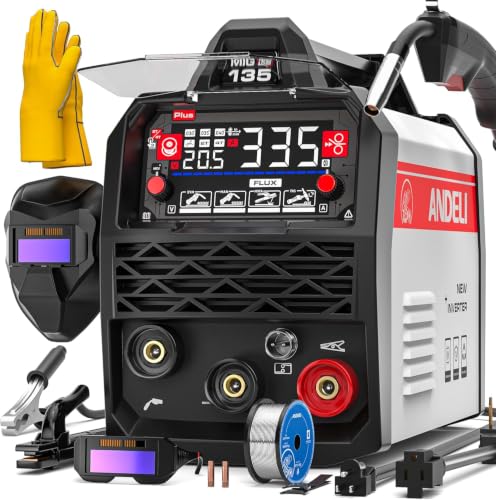
- 110V/220V dual-voltage operation
- Pulse flux-core mode with adjustable inductance
- Includes helmet, gloves, wire, and accessories
Best For: Portable gasless welding with flexible power options
Versatile 5-in-1 Pick – YESWELDER 205A MIG Welder
YESWELDER 205A MIG Welder, 110V/220V 5-In-1 MIG/Flux Core MIG/Spool Gun MIG/Lift TIG/Stick
Check Price On AmazonFor shoppers comparing mig welding machines, the YESWELDER MIG-205DS PRO stands out for its broad process support and dual-voltage flexibility. It handles gas MIG, flux-core MIG, spool-gun MIG, lift TIG, and stick welding, with synergic and manual controls for different experience levels.
Best For: DIYers, automotive work, fabrication, and users who want one machine for steel, stainless steel, and aluminum projects.
Pros:
- Five-in-one functionality with 110V/220V operation.
- Up to 200A output for thin and thick materials.
- Synergic controls simplify setup, while manual controls support experienced welders.
- Digital display and over-current, overload, overheating, and voltage-fluctuation protection.
Cons:
- Lift TIG torch and spool gun are sold separately.
- The wide range of functions may require more setup than a dedicated MIG machine.
This is a flexible choice when versatility matters most. Its combination of high output, dual voltage, and adjustable controls makes it suitable for varied workshop and job-site tasks.
Pulse Aluminum Specialist – ARCCAPTAIN MIG200P Pulse MIG Welder
Among mig welding machines, the ARCCAPTAIN MIG200P is the feature-rich option for users who want pulse welding and multi-process capability. Its pulse system is designed to reduce heat input, deformation, burn-through, and spatter, while synergic controls help match settings to the material and consumables.
Best For: Aluminum and thin-material work, garage repairs, fabrication, light industrial tasks, and welders who want pulse MIG capability.
Pros:
- Seven-in-one process support, including pulse MIG, standard MIG, flux core, lift TIG, and stick.
- Pulse welding is suited to aluminum, stainless steel, thin steel, and carbon steel.
- Large LED display with adjustable wire speed, current, voltage, burn-back, spot time, inductance, hot start, and arc force.
- Compact 32.8-pound design supports 2-pound and 10-pound wire spools.
Cons:
- Spool gun and lift TIG torch are sold separately.
- Its advanced settings may be more than beginners need for basic flux-core work.
The MIG200P is the strongest fit here for controlled, low-heat welding and aluminum-focused projects. Its portable format and 2-year manufacturer warranty add practicality for regular workshop use.
Portable Dual-Voltage Pick – YESWELDER 160A MIG Welder
The YESWELDER 160A is a practical entry in the mig welding machines category for users who need portability without giving up process flexibility. It supports gas MIG, flux-core MIG, stick, and lift TIG, and its 110V/220V compatibility makes it useful in both home and workshop environments.
Best For: Beginners, DIYers, automotive repairs, and mobile projects involving common steel wire or stick electrodes.
Pros:
- Four-in-one MIG, flux-core, stick, and lift TIG functionality.
- Synergic controls automatically recommend voltage and wire-feed settings.
- Accepts 2-pound and 10-pound spools with .030-inch and .035-inch wire.
- Compact design with carrying handle and dual-voltage operation.
Cons:
- Lift TIG torch must be purchased separately.
- Its 160A output is lower than the 200A models in this roundup.
This model balances capability and portability well. The automatic setup assistance should appeal to newer welders, while manual controls leave room for users who want to fine-tune their work.
Lightweight Flux-Core Value – AZZUNO 130A MIG Welder
The AZZUNO 130A is one of the simpler mig welding machines for home users who primarily need gasless flux-core welding. It runs on 110V, includes basic accessories and a starter roll of wire, and uses synergic controls to make initial setup easier for beginners.
Best For: Home repairs, small DIY projects, craft work, and beginners welding mild steel up to 3.0mm thick.
Pros:
- Lightweight 8.6-pound design with a comfortable carrying handle.
- Synergic adjustment automatically changes voltage and wire-feed speed.
- 130A output is rated for mild steel plates up to 3.0mm.
- Includes a MIG torch, ground clamp, brush and hammer, contact tips, and 1-pound flux-core wire.
Cons:
- Flux-core only rather than a multi-process welder.
- 110V operation and 130A output limit it to smaller projects than higher-capacity options.
- Uses a smaller 2.2-pound wire-roll capacity.
This is a straightforward choice for occasional home welding and beginners who value low weight and included accessories. It is less suitable for heavier fabrication or users seeking TIG, stick, or gas MIG capability.
Flexible Power Pick – ARCCAPTAIN 165A 4-in-1 MIG Welder
For shoppers comparing mig welding machines, the ARCCAPTAIN MIG165 stands out with four welding modes and selectable 110V or 220V input. Its 165A output, large LED display, and portable 12.8-pound design make it a versatile option for home, DIY, and mobile welding tasks.
Best For: Users who want gas MIG, flux-core MIG, Lift TIG, and stick welding in one dual-voltage machine.
Pros:
- Offers gas MIG, flux-core MIG, Lift TIG, and MMA modes.
- Supports both 110V and 220V operation with adjustable welding parameters.
- Includes a MIG torch, ground clamp, electrode holder, wire, and basic accessories.
- Built-in overload, over-current, overheating, and over-voltage protection.
Cons:
- Lift TIG torch must be purchased separately.
- Accepts only a 2-pound wire spool.
- Voltage must be changed only when the screen is off and the fan has stopped.
The ARCCAPTAIN is a strong all-around choice when flexibility matters more than large-spool capacity. Its dual-voltage design and clear display add convenience, while the included accessories help you get started quickly.
Beginner Kit Choice – BESTMIG 135A 3-in-1 Flux Welder
Among mig welding machines for new users, the BESTMIG FLUX-135 is appealing because it combines MIG, Lift TIG, and stick functions with a starter safety kit. Its 135A output is rated for material up to 1/8 inch thick, while automatic parameter adjustment simplifies setup.
Best For: Beginners who want a compact 110V welder with a helmet, gloves, wire, and core operating accessories included.
Pros:
- Provides MIG, Lift TIG, and stick welding in one machine.
- True 135A output handles material up to 1/8 inch thick.
- Includes an auto-darkening helmet, gloves, torch, cables, wire, and electrode holder.
- Digital controls automatically adjust voltage and wire-feed speed.
Cons:
- Lift TIG torch is not included.
- Designed for 110V operation rather than dual-voltage use.
- Its stated welding capacity is lower than the 165A alternatives.
The BESTMIG offers particularly good convenience for first-time welders because the package covers several essential accessories. It is best suited to lighter home, DIY, and workshop projects rather than heavier material work.
Advanced Control Pick – YESWELDER 165A 4-in-1 MIG Welder
The YESWELDER MIG-165DS PRO is one of the more configurable mig welding machines in this group, offering 110V/220V operation, four welding modes, and both synergic and manual MIG control. It also supports 2- and 10-pound wire spools and includes a detachable torch for easier setup and maintenance.
Best For: Beginners and experienced welders who want adjustable MIG controls, broad wire compatibility, and multi-process capability.
Pros:
- Combines gasless flux-core MIG, gas MIG, stick, and Lift TIG modes.
- Supports 110V and 220V input plus 2- and 10-pound wire spools.
- Synergic mode matches recommended voltage to wire-feed settings.
- Offers manual MIG adjustment, stick controls, and a detachable torch.
Cons:
- Lift TIG torch is an additional purchase.
- Listed package weight is 25.8 pounds, making it less lightweight than some compact options.
- Some useful accessories, including the TIG torch, are not included.
The YESWELDER is a well-rounded choice for buyers who expect to adjust settings as their skills develop. Its larger spool compatibility and dual-voltage input add practical flexibility, while the synergic and manual modes accommodate different experience levels.
Best Lightweight Pick – ARCCAPTAIN 135A Flux Core MIG Welder
For shoppers comparing mig welding machines for home repairs, maintenance, and portable projects, the ARCCAPTAIN MIG135 offers a compact 110V flux-core setup with MIG, lift TIG, and stick capabilities. Its digital controls automatically match recommended voltage and wire-feed settings based on wire size and material thickness, while experienced users can fine-tune the output.
Best For: Beginners and mobile DIY welders who want a lightweight, gasless multiprocess machine.
Pros:
- Lightweight 9.48-pound design with a handle and shoulder strap.
- Three welding modes: flux-core MIG, lift TIG, and MMA stick.
- Digital display, adjustable wire feed, 2T/4T control, and built-in safety protections.
Cons:
- Runs on 110V and is rated at 135A, so it is less suited to heavier-duty work than larger machines.
- A lift TIG torch must be purchased separately.
The MIG135 is a practical choice when portability and simple setup matter most. Its 2-year manufacturer warranty and protective circuitry add reassurance for occasional workshop or field use.
Best High-Output Choice – BILT HARD 250A Multi-Process MIG Welder
Among mig welding machines, the BILT HARD 250A model stands out for buyers who need broad process support and higher output. It accepts 110V or 220V power, reaches 250A, and supports gas MIG, gasless flux-core MIG, spool-gun MIG, lift TIG, stick, and spot welding.
Best For: DIYers and welders who need versatile processes, dual-voltage operation, and the capacity to weld material up to 3/8 inch.
Pros:
- Six-in-one functionality, including gas MIG, flux-core MIG, spool-gun MIG, lift TIG, stick, and spot welding.
- 110V/220V dual-voltage input with up to 250A output.
- Synergic controls, LED parameter display, 60% duty cycle at 250A, and adjustable welding functions.
Cons:
- Weighs 21.5 pounds, making it less portable than compact 135A machines.
- TIG and spool guns are not included.
This is the most capable option of the three for larger and more varied jobs. Its added weight and separate-gun requirements are trade-offs for the higher output and extensive process selection.
Best Simple Pick – ANDELI 135A Pulse MIG Welder
The ANDELI 135A is one of the more feature-rich mig welding machines for users who want gasless operation with dual-voltage flexibility. Its pulse flux-core mode is designed for smoother arc performance and more uniform beads, while synergic controls simplify setup for beginners.
Best For: Portable field work and home projects where 110V/220V flexibility, pulse flux-core welding, and included protective gear are valuable.
Pros:
- Supports 110V and 220V input, with flux-core MIG pulse, gasless MIG, lift TIG, and MMA modes.
- Pulse operation and adjustable inductance help improve arc stability and reduce spatter.
- Includes flux-core wire, accessories, an auto-darkening helmet, and leather gloves.
Cons:
- Rated at 135A, so it is intended for lighter work than the 250A alternative.
- Lift TIG torch is sold separately.
- Its listed weight is 9.04 pounds for the machine, while the complete kit will be heavier with accessories.
Choose the ANDELI when portability, dual-voltage compatibility, and a ready-to-weld accessory package outweigh the need for maximum amperage. The protected 4.1-inch display and multiple safeguards are useful additions for workshop or job-site use.
How We Picked These Mig Welding Machines
We focused on practical features that affect real-world welding: amperage range, 110V and 220V compatibility, MIG and flux-core support, multiprocess functionality, portability, spool-gun compatibility, and ease of setup. The selection includes compact machines for light repairs as well as higher-output models suited to thicker material and more demanding projects.
Because advertised output and duty cycle can vary by operating conditions, treat the ratings as a starting point. Always confirm the manufacturer’s specifications, included accessories, warranty, and recommended material thickness before buying.
Quick Comparison
- Best overall versatility: A dual-voltage multiprocess model with MIG, flux-core, lift TIG, and stick modes.
- Best for beginners: A portable 110V flux-core welder with straightforward controls and an included starter kit.
- Best for aluminum: A machine that supports a spool gun and provides suitable MIG or pulse-MIG controls.
- Best for occasional repairs: A compact 135A to 165A unit that runs from a standard household outlet.
- Best for heavier work: A 200A-plus welder with 220V input, adequate duty cycle, and appropriate wire capacity.
Key Buying Factors for Mig Welding Machines
Power and Input Voltage
110V operation is convenient for garages and job sites with standard outlets, but it limits available output. Dual-voltage machines offer more flexibility, while 220V operation generally provides better performance on thicker steel and longer welds.
Gas MIG, Flux-Core, and Wire Compatibility
Flux-core welding avoids a shielding-gas bottle and works well outdoors, although it can create more smoke and spatter. Gas MIG typically produces cleaner welds. Check supported wire diameters, spool size, polarity switching, and whether the included gun and consumables match your intended material.
Amperage, Duty Cycle, and Material Thickness
Higher amperage does not automatically mean better results. Compare the machine’s usable output and duty cycle at the voltage you expect to use. For repeated fabrication, a stronger duty cycle matters more than a high peak rating.
Controls and Extra Processes
Inductance, wire-speed, voltage, burnback, and synergic or pulse controls can improve setup and consistency. Lift TIG and stick modes are useful bonuses, but they may require separate torches, leads, or accessories.
Portability and Included Equipment
Consider weight, handle design, cable length, spool access, and storage. A helmet or starter accessories can add value, but verify their quality and budget for proper protective clothing, gloves, ventilation, and replacement consumables.
Who Should Buy Which Mig Welding Machines?
Homeowners and beginners should prioritize a simple 110V flux-core model with clear controls and manageable weight. DIY fabricators and repair users will usually benefit from a dual-voltage multiprocess machine that supports both gas and flux-core wire. Automotive and light-fabrication users should look for adjustable output, a useful duty cycle, and smooth wire feeding. Aluminum welders should choose a spool-gun-compatible or pulse-capable model and confirm that the gun, drive rollers, and settings support aluminum wire. Frequent or heavier-duty users should favor 220V capability, higher sustained output, robust cooling, and readily available replacement parts.