Fine dust, resin particles, and filing debris can quickly settle across an art studio—and become a respiratory nuisance during repeated projects. The right extractor helps capture debris at the source while keeping your workspace easier to clean.
This roundup compares 10 options across nail stations, resin work, woodworking, and general studio use, so you can match suction, filtration, capacity, and portability to your materials and workflow.
Best 10 Dust Extractors for Art Studios Picks for 2026
Flexible Fume Extraction

- 2 m reinforced flexible hose
- Three-position airflow control
- Handles fumes, dust, and debris
Best For: Directed extraction in art studios and workshops
High-Power Workshop Collection
Oneida Supercell HEPA Dust Collector

- High-pressure collection for many tools
- HEPA-GFM filtration and cyclone separation
- 14-gallon rolling dust bin
Best For: Multi-tool art studios and workshops
Quiet Bench Extraction
Adjustable Nail Dust Collector

- Adjustable suction and rotating hose
- Activated carbon filter
- Quiet 48 dB tabletop design
Best For: Small detail-work benches and compact studios
Resin Workbench Filtration

- Over 99% particle filtration claim
- Includes 100 replacement papers
- Compact and speed-adjustable
Best For: Resin, epoxy, and 3D-print finishing benches
Portable Workshop Power
DYNAVEX 12-Gallon Dust Extractor

- 142 CFM airflow from a 1.5 HP motor
- 12-gallon tank with 0.5-micron HEPA filter
- Wheeled design and automatic tool startup
Best For: Woodworking and mixed-media studios
Compact Nail-Art Capture

- 1000 Pa suction for acrylic and gel dust
- Up to eight hours of cordless operation
- Includes reusable and disposable filters
Best For: Nail-art stations and mobile pop-ups
Heavy-Duty Automated Filtration
8-Gallon 150 CFM Dust Extractor
- 150 CFM airflow with 96-inch water lift
- Automatic HEPA cleaning every 20 seconds
- Remote control and tool-triggered startup
Best For: Demanding indoor fabrication workshops
Best Portable Pick
MelodySusie HPro Nail Dust Collector

- Compact 7.67-by-2.34-inch footprint
- Three suction levels with low-noise operation
- Reusable, removable fine filter
Best For: DIY nail artists and compact studios
Best for Long Sessions
Makartt Sylvie 60W Dust Extractor

- 60W dual-turbine suction up to 5200 RPM
- Corded power for steady extended use
- Large desktop surface with reusable filter
Best For: Busy salon tables and professional nail studios
Best Filter Bundle
DC02 Dual-Fan Nail Dust Collector

- 2000PA dual-turbo suction with five speeds
- Washable HEPA filter plus 10 replacement pads
- 2-meter cord and heat-dissipation design
Best For: Studios needing adjustable filtration and supplies
Flexible Fume Extraction – Stainless Steel Hood and Hose
For dust extractors for art studios, this flexible hood-and-hose setup is a practical option when you need to position extraction close to fumes, debris, or fine dust. Its 2 m hose, adjustable airflow control, and reinforced construction suit varied workshop and studio tasks.
Best For: Art studios, workshops, salons, and work areas needing directed fume or dust extraction.
Pros:
- Flexible 2 m hose with a 68 mm internal diameter.
- Reinforced plastic resists abrasion and punctures and handles temperatures from -25°C to 90°C.
- Three-position control valve supports closed, half-open, and fully open airflow settings.
- Designed for dust, debris, vapors, fumes, and compatibility with vacuum equipment.
Cons:
- This is a hose-and-hood extraction component rather than a complete powered dust collector.
- The supplied details do not specify a filtration unit or motor.
Choose this setup when your studio already has compatible extraction equipment and you mainly need a durable, repositionable capture hood and duct.
High-Power Workshop Collection – Oneida Supercell HEPA Dust Collector
Oneida Air Systems Supercell High-Pressure Portable Freestanding HEPA-GFM Dust Collector (14-Gallon)
Check Price On AmazonAmong dust extractors for art studios, the Oneida Supercell is suited to demanding setups that connect multiple tools. Its high-pressure design, HEPA-GFM filtration, cyclone separation, and rolling stand provide a more complete collection system for studios using sanders, saws, routers, or other dust-producing equipment.
Best For: Larger art studios and workshops connecting several tools to one portable dust-collection system.
Pros:
- High-pressure suction is designed for tools with dust ports from 1 to 5 inches.
- HEPA-GFM filter with PTFE membrane and an internal pulse cleaner.
- Cyclone separator removes 99% of dust before it reaches the filter.
- Includes a 14-gallon bin, rolling stand, remote control, hose, and bin-level sensor.
Cons:
- Its 31.06 x 26.06 x 60.88-inch dimensions require substantial floor space.
- The system is intended for indoor workshop use and has one power level.
This is the strongest choice here for tool-based dust collection, especially if you need long hose runs and convenient filter and bin maintenance in a busy studio.
Quiet Bench Extraction – Adjustable Nail Dust Collector
This compact tabletop unit makes sense for dust extractors for art studios where detailed, bench-level work creates fine debris. The adjustable suction, rotating hose, LED light, and activated carbon filter are particularly useful for small workstations, though its stated applications focus on nail, dental, and model-carving tasks.
Best For: Small tabletop studios handling nail art, carving, filing, or other fine-detail work.
Pros:
- 230W brushless motor with adjustable suction and a 360° rotating hose.
- Activated carbon filter helps trap fine dust and reduce odors.
- Quiet 48 dB operation is suitable for shared workspaces.
- Compact 11 x 5.59 x 6.46-inch tabletop form with LED spotlight.
Cons:
- Its 1-liter capacity is better suited to light, localized work than heavy studio production.
- The supplied information does not position it as a general-purpose workshop dust collector.
For artists who work at a desk and need quiet, close-range collection rather than whole-room or tool-based extraction, this is a convenient compact option.
Resin Workbench Filtration – Compact Resin Dust Collector
For resin-focused dust extractors for art studios, this compact collector is designed to capture debris during sanding, drilling, polishing, and post-processing. Its adjustable suction, small footprint, and included disposable filter papers make it convenient for resin jewelry, epoxy casting, and 3D-print finishing stations.
Best For: Resin artists, jewelry makers, epoxy crafters, and compact 3D-print post-processing workstations.
Pros:
- Designed to trap over 99% of airborne particles during resin work.
- Stepless speed control allows suction adjustment for delicate or heavier tasks.
- Includes 100 disposable filter papers for quick, tool-free replacement.
- Compact design measures 6 x 6 inches and weighs under 2 pounds.
Cons:
- Disposable filter papers require ongoing replacement.
- Its compact design is intended for localized resin and craft work rather than large tools.
This is a practical bench companion for resin studios where controlling fine sanding dust and keeping surfaces clean matter more than high-volume workshop extraction.
Portable Workshop Power – DYNAVEX 12-Gallon Dust Extractor
For art studios that include woodworking, furniture making, or mixed-media fabrication, the DYNAVEX is a substantial option among dust extractors for art studios. Its 1.5 HP motor produces 142 CFM of airflow, while the 12-gallon steel tank and 0.5-micron HEPA filter support longer, cleaner work sessions.
Best For: Woodworking-focused studios needing a mobile extractor with high capacity and tool-triggered startup.
Pros:
- 12-gallon tank reduces the need for frequent emptying.
- 0.5-micron HEPA filtration helps capture fine particles.
- Auto-start function synchronizes with a connected power tool.
- Includes a hose, adapters, clamps, wheels, and replacement filters.
Cons:
- The auto-start socket supports connected tools up to 550 watts.
- Continuous auto-start operation is limited to one hour.
- Its 29.9-pound body is less convenient for highly portable setups.
The DYNAVEX offers useful capacity and filtration for studios where sawdust and routing debris are regular concerns. It is most compelling when your tools fit the auto-start limits and you want a wheeled, workshop-oriented machine.
Compact Nail-Art Capture – Nail Tech FC01 Pink Diamond
For nail artists and beauty-focused workspaces, the FC01 is a compact alternative to larger dust extractors for art studios. It uses 1000 Pa suction and cyclonic airflow to capture acrylic and gel dust, with cordless operation for up to eight hours or plug-in use for extended sessions.
Best For: Nail-art stations, client pop-ups, and compact studios that need cordless dust control.
Pros:
- Captures acrylic and gel dust with 360-degree cyclonic airflow.
- 7800 mAh battery provides up to eight hours of cordless use.
- Includes disposable pads, reusable filters, and a nail dust brush.
- Compact aluminum-and-ABS design is acetone-proof and backed by a two-year warranty.
Cons:
- Its specialized design is intended for nail dust rather than woodworking debris.
- Disposable filter pads require replacement as they become soiled.
- Maximum suction and battery runtime may vary with operating settings.
The FC01 is a focused solution for manicure and nail-art dust rather than a general-purpose shop extractor. Its small footprint, adjustable speed control, and battery operation make it practical when workspace flexibility matters most.
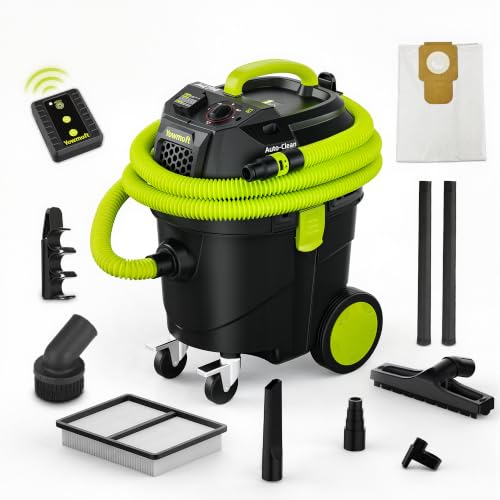
Heavy-Duty Automated Filtration – 8-Gallon 150 CFM Dust Extractor
Studios handling heavier dust, debris, or occasional liquid cleanup may prefer this 8-gallon model when comparing dust extractors for art studios. Its 1200-watt motor delivers 150 CFM airflow and 96 inches of maximum static water lift, while automatic HEPA cleaning helps maintain suction during operation.
Best For: Demanding indoor workshops that use power tools and benefit from remote control and automatic filter maintenance.
Pros:
- Automatic HEPA filter cleaning cycles every 20 seconds.
- 150 CFM airflow and 96-inch static water lift support heavy-duty extraction.
- Tool-activated startup works with connected tools up to 5 amps.
- Remote control, wet/dry capability, and overload prevention add convenience.
Cons:
- The 35.2-pound canister is relatively substantial for a studio extractor.
- Its 8-gallon capacity is smaller than some workshop-focused alternatives.
- It requires corded electric power.
This extractor stands out for automated operation and sustained suction rather than minimum size. The self-cleaning HEPA system, remote control, and wet/dry design make it a versatile choice for a busy fabrication studio with demanding cleanup needs.
Best Portable Pick – MelodySusie HPro Nail Dust Collector
For artists comparing dust extractors for art studios, the MelodySusie HPro is a compact option for small, detailed workstations. Its reusable fine filter, three suction levels, and portable 7.67-by-2.34-inch design make it easy to position on a manicure or craft table.
Best For: DIY nail artists, mobile users, and compact studio workspaces.
Pros:
- Three adjustable suction settings for different filing tasks
- Reusable filter removes for cleaning with a brush or hairdryer
- Compact, portable design with low-noise operation
- Ventilation openings help manage heat during extended use
Cons:
- Filter replacement is recommended every three to four months
- Its compact format may be less suitable for larger work surfaces
The HPro is a practical choice when portability and straightforward controls matter more than a large capture area. It fits neatly into small art or nail studios while offering adjustable suction for routine dust-producing tasks.
Best for Long Sessions – Makartt Sylvie 60W Dust Extractor
Among dust extractors for art studios, the Makartt Sylvie stands out for corded stability during extended filing sessions. Its 60W dual-turbine design, desktop-sized surface, and cooling features are suited to salon tables, beauty schools, and home workstations.
Best For: Nail professionals and studio users who need steady suction for long services.
Pros:
- Dual turbines provide airflow up to 5200 RPM
- Plug-in power supports consistent operation over long sessions
- One-knob control allows smooth suction adjustment
- Pull-out reusable filter can be cleaned with a brush or hairdryer
Cons:
- Corded design is less convenient for mobile setups
- Higher suction settings may produce more sound
- Filter should not be washed with water
The Sylvie is designed for dependable desktop use rather than portability. Its larger 9.37-by-8.94-inch surface and dual-turbine system make it a strong fit for busy stations handling acrylic, poly gel, or dip powder removal.
Best Filter Bundle – DC02 Dual-Fan Nail Dust Collector
For buyers seeking dust extractors for art studios with flexible controls and included filter supplies, the DC02 offers a practical setup. It combines dual-turbo 2000PA suction, five speed levels, a washable HEPA filter, and 10 replaceable filter pads in a slim desktop body.
Best For: Home studios, salons, and mobile nail technicians needing adjustable filtration.
Pros:
- Five suction speeds cover light buffing through heavier filing
- Includes a washable HEPA filter and 10 replacement pads
- 2-meter power cord supports flexible desk placement
- Bottom heat dissipation supports longer sessions
Cons:
- Corded electric operation requires access to an outlet
- Its 12.4-by-7.3-inch footprint may need more table space than portable models
The DC02 is a versatile option for users who value adjustable suction and a ready supply of filter pads. Its slim profile, long cord, and filter system suit varied studio layouts and recurring manicure work.
How We Picked These Dust Extractors for Art Studios
We selected models representing the main studio tasks that create airborne or settled debris: acrylic and gel nail filing, resin polishing, woodworking, welding-related fumes, and general craft cleanup. We considered suction design, filtration, hose or nozzle flexibility, collection capacity, noise-related features, portability, and the availability of replacement filters or collection media.
Because studio environments vary considerably, this list includes both compact tabletop units and larger extractors. A nail dust collector may be ideal for a dedicated manicure station but unsuitable for heavy woodworking, while a high-pressure HEPA collector may offer more capability than a small resin workspace needs.
Quick Comparison
| Studio task | Best type to consider | What matters most |
|---|---|---|
| Nail filing and acrylic work | Tabletop or portable nail dust collector | Close-range suction, quiet operation, replaceable filters |
| Resin sanding and polishing | Compact resin dust collector | Fine-particle capture, filter supply, easy cleanup |
| Woodworking and heavier debris | Portable shop-style dust extractor | Airflow, tank capacity, hose compatibility, durable construction |
| Mixed studio applications | HEPA-capable portable collector | Filtration efficiency, versatile attachments, mobility |
Key Buying Factors for Dust Extractors for Art Studios
Filtration and Particle Control
Fine dust requires more than a large collection bin. Look for a sealed design and a fine-particle or HEPA filter when sanding resin, wood, composites, or other materials that produce persistent dust. For fumes or smoke, use equipment specifically designed and rated for that contaminant; a standard dust collector is not automatically a fume extractor.
Suction and Capture Position
Extraction works best when the intake is close to the source. Flexible hoses, adjustable nozzles, rotating arms, or a broad tabletop intake can make a greater practical difference than headline motor power. Check hose diameter and attachment compatibility before buying.
Capacity, Maintenance, and Noise
Larger tanks reduce emptying frequency, but compact units are easier to keep beside a work surface. Confirm how filters are cleaned or replaced and whether consumables are readily available. If you work for long sessions, a quieter unit and adjustable speed can improve comfort and make consistent use more likely.
Portability and Electrical Setup
Measure your available space and check the extractor’s power requirements, plug type, cord length, and weight. A mobile collector is useful for shared studios, while a tabletop unit may be better for a permanent nail or resin station.
Who Should Buy Which Dust Extractors for Art Studios?
Choose a compact nail extractor if your primary work involves acrylic, gel, or manicure filing and you need close-range capture at a small station. Choose a resin-focused collector if you mainly polish or drill cured resin and value included filter media and simple cleanup.
Choose a woodworking-style extractor for larger debris volumes, power tools, or extended sanding sessions. Choose a HEPA-capable portable model when you handle varied materials and want stronger filtration with more flexible placement. For welding smoke, solvents, or other hazardous fumes, select a properly rated fume-extraction system and follow the material manufacturer’s safety guidance rather than relying on a general-purpose dust collector.