When storms, outages, evacuations, or contaminated supplies disrupt access to safe drinking water, the right purifier can make an emergency kit far more useful. The best option depends on how many people you need to support, how quickly you need treated water, and whether you can carry or store replacement supplies.
This roundup compares compact purification tablets, personal filter straws, gravity-fed systems, and electric designs to help you choose practical water treatment for home preparedness, travel, camping, and emergency situations.
Best 10 Water Purifiers for Emergencies Picks for 2026
Best Emergency Tablets
Potable Aqua Water Purification Tablets

- 100 tablets in two bottles
- Lightweight, manual treatment
- Designed for emergency and travel use
Best For: Compact emergency kits and travel
Best Certified Filter Straw
Membrane Solutions Personal Water Filter Straw S1
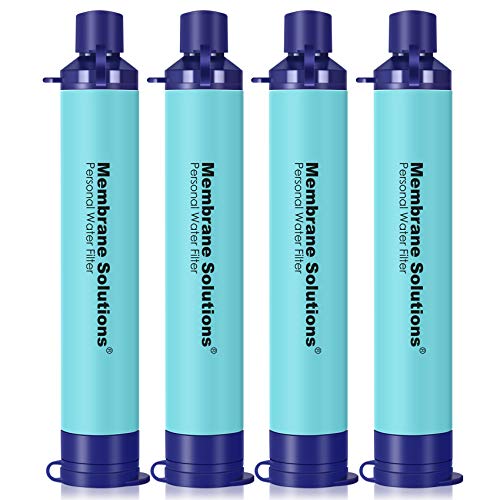
- NSF/ANSI 42, 372, and 401 certified
- Up to 1,320-gallon filter life
- Works with bottles, pouches, and gravity setups
Best For: Portable individual water filtration
Best Long-Life Filter

- Rated up to 100,000 gallons
- Removes bacteria, protozoa, and microplastics
- Includes pouch, straw, and cleaning plunger
Best For: Long-term emergency and outdoor use
Best Gravity Setup
Waterdrop Gravity Water Filter Straw
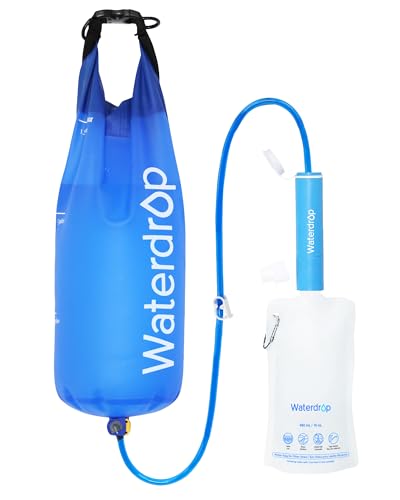
- Includes a 1.5-gallon gravity bag
- Up to 1,400-gallon filter life
- Non-electric filtration at up to 700 ml/min
Best For: Small-group emergency water treatment
Best Personal Filter
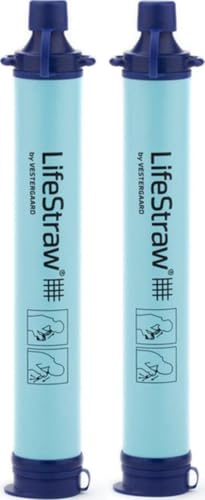
- Removes bacteria, parasites, and microplastics
- Filters up to 4,000 liters with proper maintenance
- Lightweight, power-free personal design
Best For: Solo hikers, travelers, and individual emergency kits
Best for Groups
Membrane Solutions 6L Gravity Filter
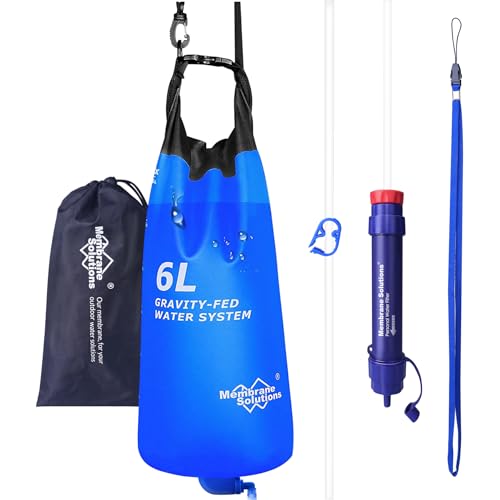
- Serves approximately 3–6 people
- Four-stage, 0.1-micron filtration
- No electricity, squeezing, or pumping required
Best For: Family camping, basecamps, and group emergency backup
Best Compact Treatment
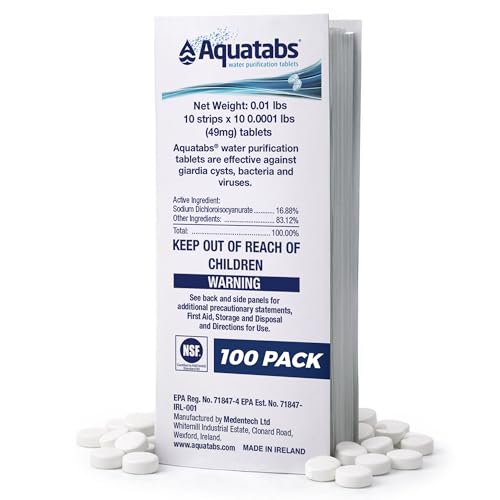
- Treats 0.75–2 liters per tablet
- Claims protection against bacteria, viruses, and Giardia cysts
- Foil-sealed, lightweight tablets for emergency kits
Best For: Bug-out bags, disaster kits, and lightweight backup treatment
Best Lightweight Gravity Filter
SimPure 3L Gravity Water Filter
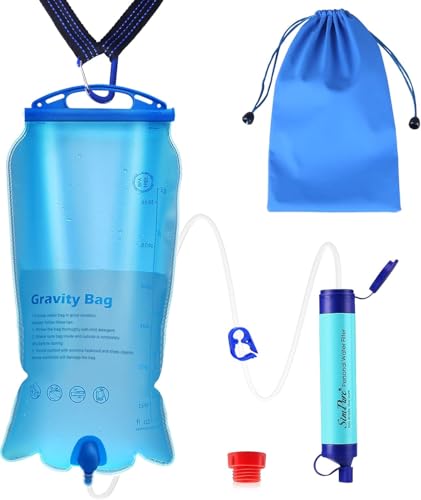
- Hands-free, non-electric gravity filtration
- 27 L/h flow and 5,000-liter filter life
- Rollable 3L bag with flexible connections
Best For: Emergency kits, backpacking, and small groups
Best Personal Emergency Filter Pack
LifeStraw 5-Pack Personal Filters
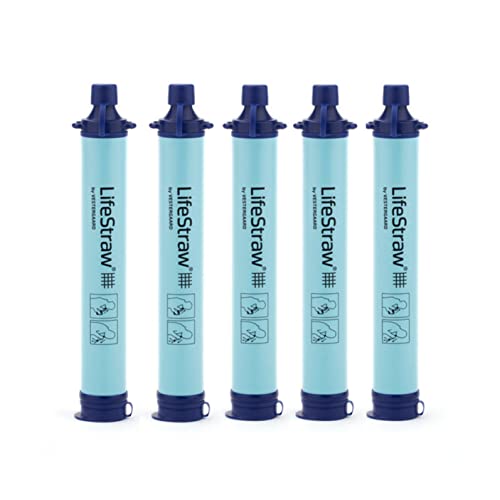
- Five individual filters for shared preparedness
- Targets bacteria, parasites, and microplastics
- No electricity or batteries needed
Best For: Families, evacuation bags, and travel
Best Powered Emergency Purifier
3-in-1 Solar and Hand-Crank Filter

- 800 mL/min automatic pumping
- USB-C, solar, and hand-crank charging
- Eight-stage filtration with pouch and LED light
Best For: Emergency kits and outdoor use with backup power
Best Emergency Tablets – Potable Aqua Water Purification Tablets
Potable Aqua tablets are a compact, manual option for anyone assembling water purifiers for emergencies. The twin pack contains 100 tablets total and is designed for treating water during camping, travel, natural disasters, and other situations where portability matters.
Best For: Lightweight emergency kits, travel, and treating water when you do not want to carry a filter.
Pros:
- Includes two bottles with 50 tablets each.
- Portable and requires no electricity or equipment.
- Makes water bacteriologically suitable to drink when used as directed.
- Effective against Giardia lamblia and intended for emergency preparedness.
Cons:
- Requires following the product directions before drinking.
- Provides chemical treatment rather than physical filtration.
- Its listed shelf life is four years, so stock rotation is important.
Choose this twin pack when storage space and simplicity are priorities. It is a practical backup for emergencies, though users should follow the label instructions carefully for each treatment.
Best Certified Filter Straw – Membrane Solutions Personal Water Filter Straw S1
The Membrane Solutions S1 is a reusable filter straw for shoppers comparing water purifiers for emergencies, hiking, or travel. Its five-stage system uses a 0.1-micron pore size, fits 28 mm threaded bottles, and is rated for up to 1,320 gallons when maintained as directed.
Best For: Individual users who want a compact, reusable straw with documented NSF/ANSI certifications and flexible connection options.
Pros:
- Certified to NSF/ANSI 42, 372, and 401 according to the supplied notes.
- Claims reduction of up to 99.9999% of total coliforms, including E. coli.
- Compact 7.1-inch, 2-ounce design with a flow rate up to 500 ml/min.
- Supports direct drinking, bottles, pouches, and gravity-fed setups.
Cons:
- Does not lower TDS, so dissolved minerals remain in the water.
- Designed primarily for individual or small-group use rather than bulk storage.
- Requires backwashing or cleaning to help maintain performance.
Its certifications, compact size, and multiple use modes make the S1 a versatile personal option. It is especially useful when you need reusable filtration without carrying a larger gravity system.
Best Long-Life Filter – Sawyer Products SP128 Mini
The Sawyer MINI is a lightweight hollow-fiber filter for water purifiers for emergencies, outdoor recreation, and travel. The 2-ounce unit connects to its included 16-ounce pouch, standard 28 mm bottles, or hydration packs, and is rated for up to 100,000 gallons.
Best For: Preparedness kits and frequent outdoor users who want a highly reusable filter with several drinking configurations.
Pros:
- 0.1-micron absolute inline filter weighs just 2 ounces.
- Removes 99.99999% of bacteria and 99.9999% of protozoa, according to the supplied notes.
- Also removes 100% of microplastics as stated in the product information.
- Includes a pouch, drinking straw, and cleaning plunger.
Cons:
- Requires manual operation and cleaning with the included plunger.
- Has a small 16-ounce pouch, so larger quantities require repeated filling.
- It is a filter rather than a chemical disinfection treatment.
The MINI stands out for its exceptionally high stated capacity and flexible connections. It is a strong choice for long-term preparedness when routine cleaning and manual operation are acceptable.
Best Gravity Setup – Waterdrop Gravity Water Filter Straw
The Waterdrop Gravity Water Filter Straw combines a reusable 0.1-micron filter with a 1.5-gallon gravity-fed bag, making it a practical choice among water purifiers for emergencies. It is built for non-electric operation and can produce flow rates up to 700 ml/min.
Best For: Small groups or households that want gravity-fed water treatment and more capacity than a personal straw alone provides.
Pros:
- Includes a 1.5-gallon gravity-fed water bag and a 16-ounce pouch.
- Five-stage filtration is designed to reduce sediment, particulates, chlorine, and odors.
- Rated for up to 1,400 gallons and up to 700 ml/min flow.
- Backwashable design supports repeated use and can connect to compatible bottles.
Cons:
- Bulkier than a standalone personal filter straw.
- Listed supported water TDS level is up to 300 ppm.
- Backwashing requires access to clean water and compatible connections.
This package is well suited to emergency scenarios where several people need treated water from a single gravity-fed setup. Its larger bag and fast stated flow rate offer more convenient batch-style use than a direct-drinking straw.
Best Personal Filter – LifeStraw 2-Pack
For lightweight water purifiers for emergencies, the LifeStraw Personal Water Filter is a compact option for individual use. Its hollow-fiber membrane requires no electricity and is rated to provide up to 4,000 liters of filtered water with proper use and maintenance.
Best For: Solo hikers, travel kits, and personal emergency bags.
Pros:
- Removes 99.999999% of bacteria and 99.999% of parasites, including Giardia and Cryptosporidium.
- Reduces microplastics, dirt, sand, and cloudiness.
- Lightweight 1.6-ounce, two-filter pack with no power requirement.
Cons:
- Designed as a personal straw rather than a group water system.
- Does not provide the larger water capacity of gravity-fed systems.
The LifeStraw is a strong choice when portability and individual access matter most. Its two-pack format also gives you a spare, but households may need a higher-volume solution.
Best for Groups – Membrane Solutions 6L Gravity Filter
Among water purifiers for emergencies, the Membrane Solutions 6L Gravity Water Filter Pro stands out for serving several people without electricity or pumping. Its gravity-fed design and 6-liter bag make it practical for basecamps, group trips, and household backup supplies.
Best For: Groups of three to six, family camping, and emergency water storage kits.
Pros:
- 6-liter capacity is designed for 3–6 people.
- Four-stage filtration uses a 0.1-micron hollow-fiber membrane, activated carbon, and PP pre-filters.
- Gravity-fed operation delivers up to 0.5 liter per minute without electricity or pumping.
- Filter life is rated up to 5,000 liters, or 1,320 gallons.
Cons:
- At 12.8 ounces, it is heavier and bulkier than a personal straw.
- Its maximum supported TDS level is listed as 500 ppm.
This system offers a useful balance of capacity, portability, and hands-off operation. It is better suited to shared water needs than individual drinking directly from a source.
Best Compact Treatment – Aquatabs 100-Pack
Aquatabs are convenient water purifiers for emergencies when storage space, weight, and simplicity are priorities. Each 49 mg tablet treats 0.75–2 liters of water; wait 30 minutes after adding a tablet according to the supplied directions.
Best For: Bug-out bags, disaster kits, hiking packs, and lightweight backup treatment.
Pros:
- Claims removal of 99.9999% of bacteria, 99.99% of viruses, and 99.9% of cysts such as Giardia.
- Individually foil-sealed tablets are compact and easy to store.
- Treated water is described as having no unpleasant taste, color, or odor like iodine-based products.
- 100-tablet pack with an expiration date of October 2030.
Cons:
- Requires a 30-minute treatment time.
- Tablets do not address sediment-heavy water; the notes recommend pairing them with a filtration system in those situations.
- Each tablet treats a limited 0.75–2 liters.
Aquatabs are an excellent space-saving backup for microbial treatment, especially when carrying a filter is impractical. For visibly dirty or sediment-heavy water, combine them with appropriate filtration.
Best Lightweight Gravity Filter – SimPure 3L Gravity Water Filter
For anyone comparing water purifiers for emergencies, the SimPure Portable Gravity-Fed Water Filter is a compact, non-electric option that can also serve as camping or backpacking gear. Hang the 3-liter bag, and gravity feeds water through the filter without pumping or squeezing.
Best For: Emergency kits, backpackers, and small groups that want hands-free filtration with a compact setup.
Pros:
- 0.1-micron hollow-fiber ultrafiltration combined with activated carbon and PP fiber filtration.
- Filters at up to 27 liters per hour and has a stated 5,000-liter lifespan.
- Lightweight, rollable design includes a 3-liter TPU bag and tree strap.
- Can be used as a personal filter, connected to a bottle, or extended with the included tube.
Cons:
- Requires a hanging point for the gravity-fed setup.
- The 3-liter bag may be limited for larger groups without repeated refills.
The SimPure is a practical choice when portability and simple, electricity-free operation matter most. Its flexible connections also make it more adaptable than a basic personal straw, while the long filter life supports repeated emergency use.
Best Personal Emergency Filter Pack – LifeStraw 5-Pack Personal Filters
The LifeStraw Personal Water Filter 5-Pack is a straightforward option for emergency preparedness when each person needs an individual drinking filter. These electricity-free hollow-fiber filters are designed for direct use with water sources and are small enough to distribute across family or evacuation kits.
Best For: Families, evacuation bags, and travelers who want several lightweight personal filters ready to distribute.
Pros:
- Pack includes five personal filters.
- Removes stated levels of waterborne bacteria, parasites, microplastics, dirt, sand, and cloudiness.
- No electricity or batteries are required.
- Each filter has a stated capacity of up to 4,000 liters with proper use and maintenance.
Cons:
- Designed as a personal drinking filter rather than a gravity system for filling containers.
- The supplied notes do not describe activated-carbon treatment for chlorine or odors.
- Users must drink through the filter rather than rely on automatic pumping.
This five-pack is especially useful when preparedness supplies need to cover multiple people without adding bulky equipment. It favors simplicity and portability, though households wanting treated water collected in a container may prefer a gravity or powered purifier.
Best Powered Emergency Purifier – 3-in-1 Solar and Hand-Crank Filter
This 3-in-1 Portable Electric Water Filter stands out among water purifiers for emergencies because it combines automatic pumping with USB-C, solar, and hand-crank charging. It draws from rivers, lakes, or streams at up to 800 milliliters per minute and includes a pouch for collecting filtered water.
Best For: Emergency kits and outdoor users who want powered flow with multiple backup charging methods.
Pros:
- Automatic 800-milliliter-per-minute flow can fill a standard 1-liter bottle in about 75 seconds.
- USB-C, solar, and hand-crank charging provide several power options.
- Eight-stage filtration uses PP cotton, activated carbon, and ultrafiltration membranes.
- Includes a 27-ounce pouch, LED light, and stated 5,000-liter filter capacity.
Cons:
- At 360 grams, it is heavier than simple personal straw filters.
- Its operation depends on a charged battery, sunlight, or time spent hand-cranking.
- The supplied notes describe reducing heavy metals and chlorine taste but do not provide specific removal percentages.
This purifier is a strong fit for users who value speed and versatility over minimum weight. Its alternative charging methods and integrated light add useful resilience during outages or extended trips, while the included pouch simplifies water collection.
How We Picked the Best Water Purifiers for Emergencies
We organized these 10 options around the main ways people treat water during disruptions: chemical purification, personal filtration, gravity-fed group filtration, and powered portable filtration. We considered portability, capacity, ease of use, intended user count, treatment speed, storage practicality, and the type of emergency for which each design is best suited.
Because no single purifier handles every contaminant or situation, we also looked for clear distinctions between products. Tablets are lightweight and simple to store, while filters are generally more convenient for repeated use. Gravity systems can serve several people without electricity, whereas electric models may be more convenient when a reliable power source is available.
Quick Comparison
| Type | Best For | Main Advantage | Important Limitation |
|---|---|---|---|
| Purification tablets | Long-term emergency storage | Very compact and lightweight | Require wait time and may affect taste |
| Filter straws | Individual use and evacuation kits | Portable and simple | Usually not ideal for groups |
| Gravity filters | Families and group camping | Treat multiple liters without pumping | Bulkier than personal filters |
| Electric filters | Convenient portable treatment | Can reduce manual effort | Depend on batteries or another power source |
Key Buying Factors for Water Purifiers for Emergencies
Filtration Versus Purification
Check what the product is designed to remove or neutralize. A filter may reduce bacteria, protozoa, sediment, and particles, but not every filter treats viruses or chemicals. Purification tablets can address biological contamination when used according to their instructions, but they do not make every chemically contaminated source safe. For uncertain water sources, read the manufacturer’s performance claims carefully and consider using multiple treatment steps.
Capacity and Group Size
A personal straw is suitable for one person drinking directly from a source or container. For a household, a gravity-fed system with a larger bag or reservoir is usually more practical. Estimate daily water needs for drinking, cooking, and basic hygiene rather than choosing solely by compactness.
Storage Life and Replacement Supplies
Emergency products should be easy to inspect and store. Check tablet expiration dates, filter replacement intervals, cleaning requirements, and whether spare cartridges are available. Keep supplies sealed, labeled, and accessible rather than buried in a rarely opened kit.
Speed, Taste, and Ease of Use
Tablets may require a treatment period, while filters can provide water more quickly but may clog in cloudy sources. Prefiltering muddy water through cloth or allowing sediment to settle can improve performance. If taste matters, select a system with an appropriate carbon stage or keep flavoring options on hand.
Who Should Buy Which Water Purifiers for Emergencies?
Choose purification tablets if you want the lightest backup for an evacuation bag, vehicle kit, or long-term emergency storage. Choose a personal filter straw for hiking, travel, or individual use when portability is the priority. Choose a gravity system for families, shelters, and group camping where several liters may be needed without electricity. Choose an electric filter when convenience is important and you can reliably recharge or replace its power source.
Whichever option you select, store enough treatment capacity for the number of people in your household, follow the instructions exactly, and maintain a separate supply of bottled or stored water for immediate needs.