The best power inverter for camping depends on what you need to run, how long you will be away, and whether you have access to a vehicle, battery pack, or generator.
We compared 10 practical options across portable power stations, vehicle inverters, pure sine wave models, and quiet inverter generators to help you choose dependable off-grid power.
Best 10 Power Inverter for Camping Picks for 2026
Best Lightweight Pick

- 292Wh capacity with 300W rated output
- Only about 7.5 pounds with multiple ports
- LiFePO4 battery and optional solar charging
Best For: Lightweight camping and personal-device charging
Best High-Power Option
LANDERPOW 3000W Pure Sine Inverter

- 3,000W continuous and 6,000W surge output
- Pure sine wave power for sensitive electronics
- Remote display, safety protections, and multiple outlets
Best For: High-demand RV and off-grid camping setups
Best Compact Battery-Free Pick

- 400W continuous and 800W peak output
- Uses EGO 56V ARC Lithium batteries
- Lightweight body with pure sine wave power
Best For: EGO battery owners needing portable campsite power
Best Midrange 12V Inverter
BELTTT 2000W Pure Sine Wave Inverter

- 2,000W continuous and 4,000W surge output
- LCD monitoring and 23-foot remote control
- Includes cables, fuses, and multiple protection features
Best For: RV and truck camping with a 12V battery system
Best Compact Car Inverter
BESTEK 300W Vehicle Power Inverter
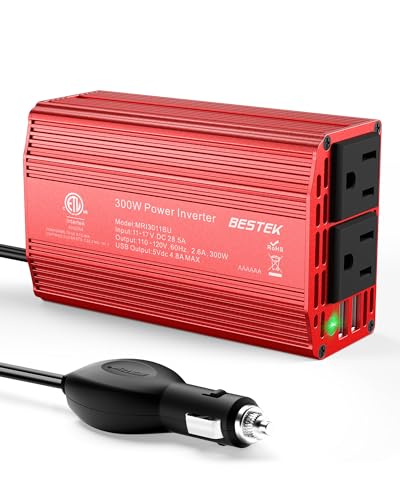
- 300W continuous and 700W peak output
- Two AC outlets plus two fast USB ports
- Compact, protected aluminum design
Best For: Personal electronics powered from a vehicle
Best Quiet Generator
AIVOLT 1600W Portable Inverter Generator
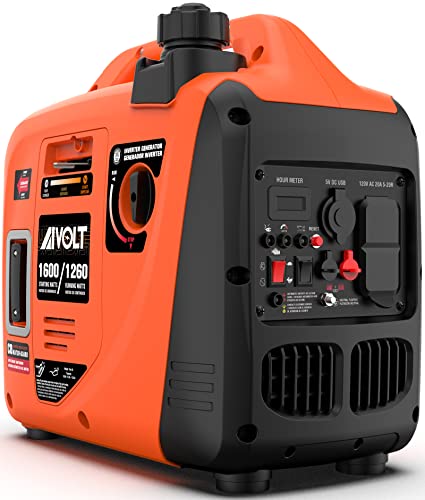
- 1,260W running and 1,600W starting power
- Clean output with less than 3% THD
- 57 dBA claimed noise level and 28-pound weight
Best For: Quiet campsite power for electronics and small equipment
Best High-Output Inverter
Cantonape 3000W 12V Power Inverter

- 3,000W continuous and 6,000W surge output
- Four AC outlets and four USB ports
- LCD monitoring and included remote control
Best For: Large 12V battery-based camping and RV setups
High-Capacity Choice

- 600W continuous and 1200W peak output
- Three AC, three USB, and one USB-C port
- LCD monitoring and six-way protection
Best For: Campers needing multiple outlets and battery-status visibility
Compact Travel Pick
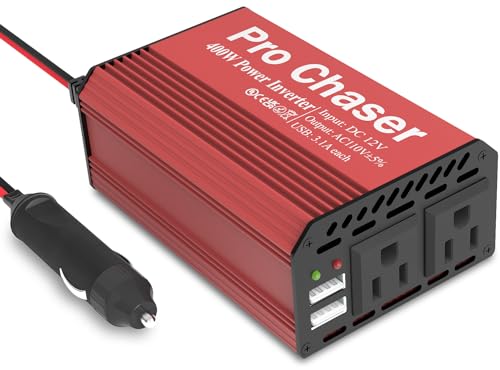
- 400W continuous and 800W peak output
- Two AC sockets and dual 3.1A USB ports
- Cellphone-sized body with 30-inch cord
Best For: Light electronics charging during road trips and camping
Flexible Connection Option
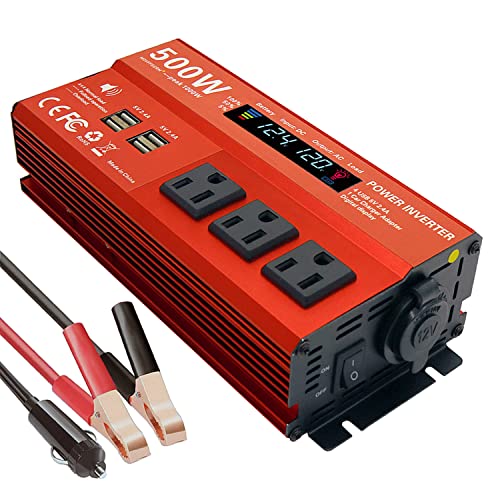
- 500W continuous and 1000W peak output
- Three AC outlets and four USB ports
- Cigarette-lighter plug plus battery clips
Best For: Campers switching between vehicle and 12V battery power
Best Lightweight Pick – Jackery Explorer 300
If you want a compact power inverter for camping, the Jackery Explorer 300 combines a 292Wh battery with 300W of rated output in a portable 7.5-pound design. Its AC, USB, USB-C, and car-port connections make it useful for charging personal electronics and select small appliances away from the grid.
Best For: Campers, hikers, and travelers who prioritize portability, versatile charging, and solar-compatible backup power.
Pros:
- Lightweight design with an integrated carrying handle
- Two AC outlets plus USB-C, USB-A, and 120W car-port outputs
- LiFePO4 battery rated for more than 4,000 charge cycles
- Can reach 80% charge in about 2.8 hours with a 100W Jackery solar panel
Cons:
- 300W continuous output is not intended for high-draw appliances
- Solar panel is optional
- Requires a physical delivery address rather than only a PO Box
The Explorer 300 is a practical choice when low weight and flexible device charging matter more than running large equipment. Its long-life battery and optional solar charging add useful capability for extended camping trips.
Best High-Power Option – LANDERPOW 3000W Pure Sine Inverter
For campsite setups connected to a substantial 12V battery bank, this LANDERPOW unit is a high-output power inverter for camping with 3,000W continuous power and 6,000W surge capacity. Its pure sine wave output is designed for sensitive electronics and demanding startup loads.
Best For: RV campers, off-grid users, and job-site setups needing to operate multiple or high-draw AC devices from a 12V battery system.
Pros:
- 3,000W continuous and 6,000W peak output
- Pure sine wave power for sensitive and inductive loads
- Three AC outlets, a hardwired terminal, USB ports, and a 30W PD port
- Includes thick 1 AWG battery cables and a 15-foot wired remote
Cons:
- Requires a compatible 12V battery source and proper installation
- Much less portable than a self-contained power station
- High-power loads can require substantial battery capacity and wiring
This inverter makes the most sense when your camping system already has a capable 12V battery bank and you need serious AC output. The remote display and built-in protection features are useful for RV or campsite installation.
Best Compact Battery-Free Pick – EGO POWER+ 400W Inverter
The EGO POWER+ PAD5000 is a small, 3.3-pound power inverter for camping that uses EGO 56V ARC Lithium batteries, sold separately. It provides 400W continuous output, 800W peak power, a 120V outlet, and several USB charging options in a compact package.
Best For: EGO battery owners who need quiet, portable power for smaller electronics, USB devices, and occasional 120V loads.
Pros:
- Lightweight 3.3-pound design
- Pure sine wave output for sensitive electronics
- 100W USB-C PD port can power devices or charge compatible EGO batteries
- Pass-through charging and built-in LED lighting add convenience
Cons:
- EGO battery and charger are not included
- 400W continuous output limits the appliances it can run
- Only one 120V AC outlet
This is a convenient option for campers already invested in the EGO 56V battery platform. Its low weight and USB-C capability are appealing for personal electronics, but buyers starting from scratch should account for the separate battery cost.
Best Midrange 12V Inverter – BELTTT 2000W Pure Sine Wave Inverter
The BELTTT BAP2000A is a strong choice for a permanently connected power inverter for camping when you need more output than a compact power station provides. It converts 12V battery power to 2,000W of pure sine wave AC power, with up to 4,000W available for startup surges.
Best For: RVs, trucks, and off-grid campsites that need to run sensitive electronics and moderate-to-high-draw AC equipment from a 12V battery system.
Pros:
- 2,000W continuous and 4,000W peak output
- Pure sine wave output supports sensitive and inductive loads
- LCD displays input, output, battery, and load status
- Includes 23-foot remote, battery cables, and multiple safety protections
Cons:
- Requires a separate 12V battery or solar-battery system
- Installation and heavy-gauge wiring are needed for full output
- One-year warranty is shorter than some competing options
With its LCD monitoring, remote control, and 93% stated maximum efficiency, the BELTTT offers a capable middle ground for vehicle-based camping. It is best treated as an installed inverter rather than a grab-and-go power station.
Best Compact Car Inverter – BESTEK 300W Vehicle Power Inverter
For campers who mainly need to charge personal electronics from a vehicle, the BESTEK 300W is a compact power inverter for camping with two AC outlets and two USB ports. Its 32-inch cigarette-lighter cable and 11–17V vehicle compatibility make it convenient for road trips, camping, and RV use.
Best For: Charging laptops, phones, cameras, and other smaller electronics from a compatible vehicle.
Pros:
- Provides 300W continuous power and 700W peak power.
- Includes two AC outlets and dual 4.8A USB charging ports.
- Compact aluminum housing, built-in protections, and a temperature-controlled cooling fan.
- Includes a 60-month product replacement warranty according to the supplied product notes.
Cons:
- Modified sine wave output may not suit every appliance.
- Designed for relatively low-power electronics rather than high-wattage camping equipment.
- Requires a compatible 11–17V vehicle power connection.
The BESTEK is a practical choice when portability and easy vehicle charging matter more than high output. It is especially suitable for keeping personal devices powered during car-based camping trips.
Best Quiet Generator – AIVOLT 1600W Portable Inverter Generator
The AIVOLT 1600W is a fuel-powered power inverter for camping that offers substantially more capacity than a vehicle plug-in inverter. It delivers clean inverter power for sensitive electronics, runs at a claimed 57 dBA, and weighs 28 pounds for easier transport to a campsite.
Best For: Campers who need quiet, portable power for electronics, small tools, a camping fridge, or similar equipment.
Pros:
- Provides 1,260W running power and 1,600W starting power with less than 3% THD.
- Offers up to 8 hours of runtime at 25% load, according to the supplied notes.
- Includes two 120V outlets, Type-A and Type-C USB ports, and parallel capability.
- CO protection, low-oil shutdown, and overload protection add useful safety features.
Cons:
- Requires gasoline and outdoor operation, unlike a battery-based inverter.
- Engine oil is not included.
- Parallel kit is not included, and the product is not approved for California use according to the supplied notes.
Choose the AIVOLT when you need generator-level output without the bulk of larger units. Its clean power and quiet operation make it a strong fit for electronics-focused camping, provided fuel use and maintenance are acceptable.
Best High-Output Inverter – Cantonape 3000W 12V Power Inverter
For demanding campsite setups, the Cantonape 3000W is a high-output power inverter for camping that converts 12V battery power to 110V/120V AC. It supplies four AC outlets, four USB ports, and up to 6,000W of surge power, making it suited to multiple connected devices and heavier loads.
Best For: Battery-powered camping, RV, truck, boat, or outdoor setups that need several outlets and substantial continuous output.
Pros:
- Delivers 3,000W continuous power and 6,000W surge power.
- Provides four AC outlets and four 3.1A USB ports.
- LCD displays input and output voltage, battery capacity, load capacity, frequency, and fault codes.
- Includes remote control, battery cables, multiple protection systems, and a temperature-controlled fan.
Cons:
- Uses modified sine wave output, which may not be appropriate for every appliance.
- Requires a suitable 12V battery system; the supplied notes reference a 100Ah battery capacity.
- High output can place significant demands on the battery and wiring.
The Cantonape is the most capable option here for running several loads from a 12V battery bank. Its LCD monitoring and remote control are useful for larger camping or RV installations, but the required battery capacity and modified sine wave output deserve careful consideration.
High-Capacity Choice – 1200W Peak Car Inverter
For campers who need several charging options, this power inverter for camping delivers 600W of continuous power and up to 1200W peak output. It includes three AC outlets, three USB ports, and one USB-C port, while the LCD keeps key operating information visible.
Best For: Camping setups, road trips, RV use, and emergency power from a 12V battery.
Pros:
- Three AC outlets plus USB and USB-C charging ports
- LCD shows input voltage, output voltage, and battery level
- Temperature-controlled cooling fan is designed for quieter operation
- Includes overvoltage, undervoltage, overload, overtemperature, short-circuit, and reverse-polarity protection
Cons:
- Uses a modified sine wave output
- Its listed continuous rating is 600W, despite the 1200W peak rating
- At nearly 12 inches long, it is less compact than cellphone-sized alternatives
This is a practical pick when outlet count and status monitoring matter more than minimum size. For higher loads, connect it to an appropriate deep-cycle battery rather than relying only on a vehicle accessory socket.
Compact Travel Pick – Pro Chaser 400W Inverter
This compact power inverter for camping is suited to lighter-duty charging from a vehicle’s 12V system. It provides 400W of continuous power, 800W peak output, two AC sockets, and two USB ports in a cellphone-sized design with a 30-inch cord.
Best For: Road trips, compact camping kits, and charging laptops, phones, tablets, cameras, or similar travel electronics.
Pros:
- Small, lightweight design at 14.08 ounces
- Two AC outlets and two 3.1A USB ports
- 30-inch cord provides flexible placement in a vehicle
- Built-in protection and a temperature-activated cooling fan
Cons:
- 400W continuous output is intended for lighter loads
- Modified sine wave output may not suit every device
- Requires a cool, dry operating environment
The Pro Chaser emphasizes portability and straightforward travel charging rather than high-capacity appliance use. Its compact body and flexible cord make it convenient for campers carrying a small electronics-focused setup.
Flexible Connection Option – 500W Multi-Outlet Inverter
For campers who want both vehicle-socket convenience and battery flexibility, this power inverter for camping offers 500W continuous power and 1000W peak output. It has three AC outlets, four USB charging ports, an LCD, and both a cigarette-lighter plug and battery clips.
Best For: Camping and emergency setups that may power several small electronics from either a vehicle outlet or a 12V battery.
Pros:
- Three AC outlets and four 2.4A USB ports
- Includes both a cigarette-lighter plug and battery clips
- LCD display provides operating information
- Aluminum body and fan support heat dissipation, with multiple protection features
Cons:
- Uses modified sine wave output
- Loads above 150W should use the battery clips rather than the cigarette-lighter plug
- At 2.2 pounds, it is heavier than the compact Pro Chaser option
This model stands out for connection flexibility and its large number of charging ports. Pay close attention to the 150W cigarette-lighter guidance when using it in a vehicle, especially with multiple devices connected.
How We Picked the Best Power Inverter for Camping
We evaluated these products by matching their output, connection type, portability, and intended use. The lineup includes compact 300W to 400W vehicle inverters for phones and small electronics, midrange models with USB-C and multiple AC outlets, and larger 1,600W to 3,000W units designed for RVs or demanding campsite loads.
We also considered waveform quality, surge capacity, battery requirements, noise, display features, and convenience. A portable power station such as the Jackery Explorer 300 includes its own battery, while a 12V inverter requires a suitable car, RV, or deep-cycle battery. Inverter generators are a separate category: they produce power with an engine and fuel rather than converting stored DC power.
Quick Comparison
| Best For | Recommended Type | What to Look For |
|---|---|---|
| Phones, lights, and small chargers | 300W–500W car inverter | USB ports, fused plug, compact design |
| Laptops and sensitive electronics | Pure sine wave inverter | Clean AC output and sufficient continuous wattage |
| Several devices at once | 800W–1,600W inverter | Multiple outlets, heavy-duty cables, battery capacity |
| RV appliances and high loads | 2,000W–3,000W inverter | Direct battery connection, surge rating, ventilation |
| Extended high-power camping | Inverter generator | Fuel runtime, noise rating, emissions compliance |
Key Buying Factors for a Power Inverter for Camping
Continuous and Peak Wattage
Use continuous wattage for the device’s normal demand and peak or surge wattage for startup loads from motors, compressors, and some appliances. Add the running watts of everything you may use simultaneously, then leave headroom rather than choosing an inverter at its limit.
Waveform and Compatibility
Pure sine wave output is the safest choice for laptops, medical equipment, audio gear, and appliances with variable-speed motors. Modified-sine models can cost less, but compatibility and performance vary by device.
Power Source and Runtime
A car-plug inverter is convenient for modest loads but is limited by the vehicle socket and alternator. High-output 12V models normally need direct battery connections and substantial cables. For runtime, compare battery watt-hours—not just inverter wattage. A generator can run longer with fuel but adds noise, maintenance, and ventilation requirements.
Ports, Safety, and Portability
USB-A, USB-C, and multiple AC outlets reduce the need for adapters. Look for low-voltage, overload, overheat, and short-circuit protection. Confirm cable length, cooling clearance, weight, and whether the unit can be safely transported and stored.
Who Should Buy Which Power Inverter for Camping?
Choose a compact car inverter if you mainly need to charge phones, cameras, tablets, or a laptop during road trips. Choose a portable power station if you want quiet, rechargeable power with built-in battery storage and simple setup. Select a pure sine wave 12V inverter for sensitive electronics or an RV battery system, provided you have the correct battery and installation hardware.
For heating appliances, refrigerators, power tools, or several high-draw devices, move to a higher-output direct-battery inverter or an inverter generator. Before buying, check every device’s starting wattage, verify the inverter’s continuous rating, and never operate fuel-burning equipment inside a tent, vehicle, or enclosed shelter.