A reliable charger with engine-start capability can do more than restore a weak battery. It can provide a practical backup when a vehicle will not start, while also maintaining batteries during storage and regular use.
This roundup compares 10 battery chargers with engine start mode, ranging from compact smart maintainers to wheeled high-output starter-chargers. The right choice depends on your vehicle type, battery voltage, charging speed needs, and available storage space.
Best 10 Battery Chargers with Engine Start Mode Picks for 2026
Best Smart Charger
TowerTop 25A Charger with Engine Start

- Adjustable 2A/10A/25A and automatic charging
- 100A engine-start and winter modes
- Eight-stage charging with repair and maintenance
Best For: Automatic 12V charging and battery care
Best Heavy-Duty Starter
Schumacher SC1445 250A Wheeled Charger

- 250A 12V engine-start output
- 6V/12V compatibility for varied batteries
- 25A and 50A boost charging with wheels
Best For: Workshops needing maximum starting power
Best Diagnostic Charger

- 30A charging and 3A maintenance
- 100A engine-start assistance
- LCD, reconditioning, and alternator diagnostics
Best For: 12V charging with basic electrical diagnostics
Best Wheeled Value
Schumacher SC1446 200A Charger and Starter

- 200A 12V engine-start output
- 6V/12V support with 20A and 40A boosts
- Wheeled steel design with timer and ammeter
Best For: Garages handling varied vehicles and battery voltages
Balanced 12V Choice
Smart Charger and 50A Engine Starter

- 2A/6A charging, 10A boost, and 50A engine start
- Works with STD, AGM, and GEL 12V batteries
- Ammeter, LED status indicators, and reverse-polarity protection
Best For: Routine 12V charging, maintenance, and occasional engine starting
Heavy-Duty Start Power
Schumacher Wheeled Charger and Maintainer

- 150A engine start and 20A boost charging
- Automatic 2A–6A charging with smart trickle maintenance
- Designed for cars, trucks, SUVs, boats, motorcycles, and ATVs
Best For: Garage use and vehicles needing high-output starting assistance
Maximum Versatility
12V/24V 50A Charger with 250A Start

- 12V/24V support with up to 50A fast charging
- 250A engine start plus winter, repair, and desulfation modes
- Seven-stage automatic cycle and broad lead-acid compatibility
Best For: Multi-voltage vehicle owners and advanced battery maintenance
Best Overall 6V/12V Power

- 100A engine start with 12–30A boost
- Automatic 6V/12V charging and maintenance
- Testing and desulfation functions included
Best For: Multi-vehicle battery charging and maintenance
Best High-Output 12V/24V Pick
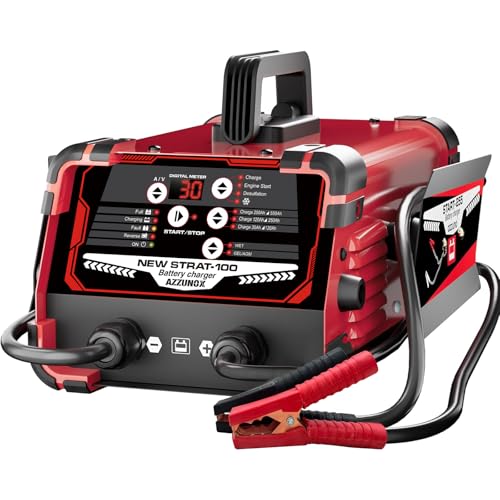
- 12V/24V compatibility with up to 30A charging
- 130A cranking surge for engine starts
- Winter, repair, desulfation, and maintenance modes
Best For: Higher-output charging across 12V and 24V lead-acid systems
Best Diagnostic Features

- 100A engine start and 30A boost
- Built-in battery and alternator testing
- Automatic 6V/12V charging and float maintenance
Best For: Garage users who want charging plus diagnostics
Best Smart Charger – TowerTop 25A Charger with Engine Start
For drivers seeking battery chargers with engine start mode, the TowerTop combines automatic 12V charging, battery maintenance, repair functions, and a 100A starting boost. Its adjustable 2A, 10A, 25A, and automatic settings make it adaptable for everyday vehicles, storage batteries, and deep-cycle applications.
Best For: Vehicle owners who want an automatic 12V charger with repair, winter, and maintenance modes.
Pros:
- Offers 2A, 10A, 25A, and automatic charging settings.
- Includes a 100A engine-start function and winter mode.
- Supports STD, AGM, GEL, wet, EFB, calcium, and deep-cycle 12V batteries.
- HD display, eight-stage charging, automatic maintenance, and multiple safety protections.
Cons:
- Engine-start output is lower than the wheeled Schumacher models.
- Designed for 12V batteries rather than both 6V and 12V systems.
- Repair mode cannot restore completely drained batteries.
The TowerTop is the most feature-rich choice here for users prioritizing automatic charging and battery-care functions. Its engine-start mode adds emergency utility without sacrificing long-term maintenance features.
Best Heavy-Duty Starter – Schumacher SC1445 250A Wheeled Charger
The Schumacher SC1445 is a heavy-duty option among battery chargers with engine start mode, delivering a 250A 12V starting output from a wheeled, manual-timer-controlled chassis. It also provides 25A and 50A boost charging and supports both 6V and 12V batteries.
Best For: Garages, workshops, and vehicle owners who need maximum starting power and broad battery-voltage compatibility.
Pros:
- Delivers a powerful 250A engine-start output.
- Supports 6V and 12V standard, AGM, gel, and deep-cycle batteries.
- Includes 25A and 50A boost settings for deeply discharged batteries.
- Wheeled design improves mobility despite its substantial size.
Cons:
- Manual timer control requires more user involvement.
- At 28.8 pounds, it is less portable than compact chargers.
- It does not offer the automatic maintenance and display features listed for the TowerTop.
Choose the SC1445 when engine-start strength matters more than compactness or automation. Its 6V/12V support and wheeled construction make it particularly practical for varied automotive, marine, and power-sport equipment.
Best Diagnostic Charger – DEWALT DXAEC100 30A Charger
The DEWALT DXAEC100 balances 30A charging, 3A maintenance, and 100A engine-start assistance in a relatively compact unit. For shoppers comparing battery chargers with engine start mode, its LCD controls, automatic reconditioning, reverse-polarity warning, and alternator diagnostics add useful troubleshooting capability.
Best For: 12V automotive and marine battery owners who want charging, maintenance, and basic electrical-system diagnostics in one device.
Pros:
- Combines 30A charging, 3A maintenance, and 100A engine-start assistance.
- Compatible with 12V wet, gel, and AGM lead-acid batteries.
- LCD display shows charging and battery-status information.
- Includes automatic reconditioning, alternator checking, and reverse-polarity protection.
Cons:
- Limited to 12V batteries.
- Does not list support for deep-cycle batteries in the supplied specifications.
- Its stated charge time is 12.5 hours, so charging speed depends on the battery and conditions.
The DXAEC100 is a well-rounded pick for users who want more than emergency starting. Its alternator check and reconditioning function make it useful when diagnosing whether a weak battery or vehicle charging system is the underlying issue.
Best Wheeled Value – Schumacher SC1446 200A Charger and Starter
The Schumacher SC1446 is a practical manual charger and starter for drivers who want strong output without giving up 6V/12V flexibility. It provides a 200A 12V engine start, 40A and 20A boost charging, and a 10A 12V charging mode in a sturdy wheeled design.
Best For: Home garages and workshops serving cars, trucks, motorcycles, RVs, marine equipment, and other 6V/12V applications.
Pros:
- Provides 200A 12V engine-start power.
- Supports 6V and 12V standard, AGM, gel, and deep-cycle batteries.
- Offers 40A and 20A boost charging plus 10A 12V charging.
- Features a 135-minute timer, analog ammeter, steel case, clamps, handle, and wheels.
Cons:
- Manual operation requires monitoring and adjustment.
- Its nearly 30-pound wheeled body is not ideal for carrying.
- It must be plugged into AC power during use.
The SC1446 suits buyers who prefer straightforward controls and rugged mobility over smart automation. It is especially appealing when one charger needs to handle different vehicle types and both 6V and 12V batteries.
Balanced 12V Choice – Smart Charger and 50A Engine Starter
If you need battery chargers with engine start mode for everyday 12V vehicles, this Banshee unit combines selectable charging, maintenance, and starting functions. It supports standard, AGM, and gel lead-acid batteries and includes an ammeter for monitoring charging current.
Best For: Drivers, RV owners, marine users, and powersports owners who want flexible 12V charging with a 50A engine-start function.
Pros:
- Offers 2A and 6A charging, 10A boost charging, and 50A engine starting.
- Supports STD, AGM, and GEL 12V lead-acid batteries.
- Reverse hook-up protection helps reduce connection-related damage.
- Built-in ammeter and LED indicators make charging progress easier to monitor.
Cons:
- Limited to 12V batteries.
- Engine-start output is lower than the 150A and 250A ratings of the other options here.
This is a practical choice when you want one straightforward 12V charger for routine maintenance and occasional starting assistance. Its selectable low-current settings are useful for maintaining batteries, while the boost and start modes add flexibility.
Heavy-Duty Start Power – Schumacher Wheeled Charger and Maintainer
For shoppers comparing battery chargers with engine start mode, the Schumacher SC1364 emphasizes high starting power and broad vehicle compatibility. Its wheeled design, automatic operation, boost mode, and maintenance functions make it suited to garages managing multiple battery types.
Best For: Car, truck, SUV, boat, motorcycle, and ATV owners who want a high-output charger with a 150A engine-start function.
Pros:
- Provides a 150A engine start and 20A boost charge.
- Supports standard and AGM batteries across a wide range of vehicles.
- Microprocessor-controlled charging adjusts from 2A to 6A and includes smart trickle maintenance.
- Reverse hook-up protection helps prevent operation when clamps are connected incorrectly.
Cons:
- Its wheeled form factor is substantially larger and heavier than compact chargers.
- The supplied details specify compatibility with standard and AGM batteries rather than the broader chemistry range of some alternatives.
The SC1364 is the strongest fit when engine-start capability is a priority and portability is less important. Its automatic charging and maintenance features also make it useful for vehicles that spend time parked or in storage.
Maximum Versatility – 12V/24V 50A Charger with 250A Start
This AZZUNOX model stands out among battery chargers with engine start mode by supporting both 12V and 24V systems. It combines fast charging, maintenance, desulfation, repair, winter operation, and a 250A cranking function for a broad range of lead-acid applications.
Best For: Users who need one multifunction charger for 12V and 24V cars, boats, RVs, power-sports equipment, and compatible deep-cycle batteries.
Pros:
- Supports 12V and 24V batteries with charging rates up to 50A on 12V.
- Includes a 250A cranking engine-start mode and winter mode.
- Seven-stage automatic charging includes desulfation, absorption, float, and maintenance phases.
- Offers broad lead-acid compatibility, including AGM, GEL, EFB, calcium, MF, and deep-cycle batteries.
Cons:
- It will not charge or jump-start batteries below 1V.
- The extensive modes and settings may be more capability than a basic 12V user needs.
- Engine-start and charging performance depend on using the appropriate battery voltage and mode.
Choose this unit if voltage flexibility and multiple battery-care functions matter more than simple operation. Its 24V support and 250A starting rating make it the most versatile option in this group, while the automatic cycle reduces the need for constant manual adjustment.
Best Overall 6V/12V Power – Schumacher SC1281
The Schumacher SC1281 is a versatile choice among battery chargers with engine start mode, combining a 100-amp engine start with 12- to 30-amp boost charging. Its automatic 6V/12V detection, testing functions, and maintenance mode make it suitable for everyday vehicles and batteries stored between uses.
Best For: Drivers who want one charger for cars, trucks, motorcycles, ATVs, SUVs, boats, and other compatible 6V or 12V batteries.
Pros:
- 100-amp engine start and 12- to 30-amp boost modes
- Supports standard, AGM, gel, and deep-cycle batteries
- Automatic maintenance, battery testing, alternator testing, and desulfation
- Automatically detects 6V and 12V batteries
Cons:
- At 12.7 pounds, it is heavier than many compact maintainers
- Its listed battery charge time is 10 hours
With a broad compatibility range and several diagnostic and recovery functions, the SC1281 is a strong all-purpose option. Its 1-year warranty and automatic maintenance mode add practical value for regular vehicle care.
Best High-Output 12V/24V Pick – AZZUNOX 30A Charger
For shoppers comparing battery chargers with engine start mode, this AZZUNOX model stands out with 12V/24V compatibility, up to 30 amps of charging current, and a 130-amp cranking surge. It also adds winter, repair, desulfation, and automatic maintenance modes for broader battery-care needs.
Best For: Owners of 12V or 24V lead-acid batteries in cars, boats, RVs, and power-sports equipment who want higher charging output.
Pros:
- Supports both 12V and 24V lead-acid batteries
- 130-amp engine-start surge and up to 30-amp charging
- Seven-stage automatic charging cycle with float maintenance
- Includes winter, repair, and desulfation modes
Cons:
- Will not charge or jump-start batteries below 1V
- Its compatibility is specified for lead-acid battery types
The AZZUNOX is the most output-focused option in this group, particularly for users who need 24V support or faster charging. Its multilayer safety system and cooling fan are useful additions during extended high-current operation.
Best Diagnostic Features – Schumacher SC1308
The Schumacher SC1308 is a practical choice among battery chargers with engine start mode when diagnostics matter. It combines a 100-amp engine start, 30-amp boost, 6-amp charging, and 2-amp maintenance with built-in battery and alternator testing.
Best For: Vehicle owners who want charging, starting, maintenance, and basic battery-system testing in one 6V/12V unit.
Pros:
- Six functions include starting, charging, maintaining, testing, desulfation, and alternator testing
- 100 cranking amps and 30-amp boost support larger batteries
- Works with 6V and 12V standard, AGM, and deep-cycle batteries
- Automatic shutoff, float monitoring, and reverse hook-up protection
Cons:
- Weighs 12.6 pounds, so it is not especially lightweight
- Its listed battery charge time is 10 hours
The SC1308 is well suited to garages where one device needs to do more than charge. Its diagnostic tools and automatic transition to maintenance mode make it especially useful for checking battery condition while keeping batteries ready.
How We Picked the Best Battery Chargers with Engine Start Mode
We focused on chargers that combine battery charging with a dedicated engine-start function, then compared their output, supported voltage systems, charging flexibility, maintenance features, portability, and controls. The selection includes compact 12V models for everyday cars, dual-voltage units for broader garage use, and wheeled high-output chargers designed for larger vehicles or demanding starts.
Smart charging and automatic maintenance were also important. These features can help reduce overcharging risk and make a charger more useful for seasonal vehicles, stored cars, motorcycles, and backup power needs. Because engine-start ratings are intended for short starting assistance rather than continuous cranking, we also considered whether each design appears suited to occasional emergencies or more frequent workshop use.
Quick Comparison
| Best For | What to Look For |
|---|---|
| Emergency starting | Higher engine-start amperage, clear controls, and heavy-duty cables |
| Routine car charging | Automatic operation, selectable amperage, and 12V compatibility |
| Stored vehicles | Float or maintenance mode and automatic monitoring |
| Large vehicles | 6V/12V or 12V/24V support, high output, and wheeled portability |
| Limited storage | Compact housing, integrated handles, and lighter weight |
Key Buying Factors for Battery Chargers with Engine Start Mode
Engine-Start Output
Starting amperage is the headline specification, but it is not the only consideration. A higher rating may be helpful for trucks, older vehicles, or severely discharged batteries, while a lower-output unit can be adequate for a typical passenger car. Always follow the manufacturer’s recommended duty cycle and allow the charger to cool between starting attempts.
Voltage and Battery Compatibility
Most household vehicles use 12V systems, but some equipment and classic vehicles use 6V, while commercial applications may require 24V. Confirm voltage compatibility before buying. Also check whether the charger supports the battery chemistry in your vehicle, such as conventional flooded lead-acid, AGM, or gel batteries.
Charging Control and Safety
Automatic shutoff, smart charging, reverse-polarity protection, short-circuit protection, and overcharge prevention make a charger easier and safer to use. A digital display or clear status indicators can also help you verify charging progress without guessing.
Portability and Controls
Wheeled models are useful when high-output hardware is too heavy to carry, but they need more garage or workshop space. Compact chargers are easier to store and transport. Consider cable length, clamp quality, handle design, and whether the controls remain readable in low light.
Who Should Buy Which Battery Chargers with Engine Start Mode?
Choose a Compact Smart Charger for Everyday Maintenance
Drivers who mainly need dependable charging and storage maintenance should favor automatic 12V models with selectable amperage and a dedicated start mode. They are practical for cars, seasonal vehicles, and home emergency kits.
Choose a Wheeled Starter-Charger for Larger Vehicles
If you regularly work on trucks, equipment, or multiple vehicles, a wheeled high-output model can be easier to position and more capable during difficult starts. Dual-voltage support is especially valuable in a mixed-use garage.
Choose a Simple Maintainer for Occasional Use
For a vehicle that only needs periodic charging, a lower-amperage 6V/12V charger may provide the best balance of cost, storage convenience, and straightforward operation. Before connecting any model, inspect the battery, verify polarity, and follow the included safety instructions.