The best pipe cutter depends on more than price. Tube diameter, pipe material, workspace clearance, and cutting speed all determine whether a compact manual tool or a powered model is the better fit.
This roundup compares 10 pipe cutters under $500, from close-quarters tubing cutters and PVC ratchet tools to heavy-duty steel and oversized-pipe options. Use the guide below to narrow your choice by application and capacity.
Best 10 Pipe Cutters Under 500 Picks for 2026
Best Compact Pick
RIDGID Model 101 Close Quarters Cutter

- Compact for tight spaces
- Cuts copper, aluminum, brass, and plastic
- Includes a spare cutter wheel
Best For: Small-diameter tubing and restricted-access plumbing
Best Wide-Range Option

- Cuts 3/16-inch to 2-inch tubing
- Six rollers support stable cutting
- Includes a deburring tool
Best For: Wide-ranging metal-tubing work
Best Premium Tubing Design

- Cuts tubing from 1/8 to 1-1/8 inches
- Enclosed feed screw helps prevent jamming
- Includes reamer and spare wheel
Best For: Repeated copper, brass, aluminum, and conduit cuts
Best Plastic-Pipe Pick
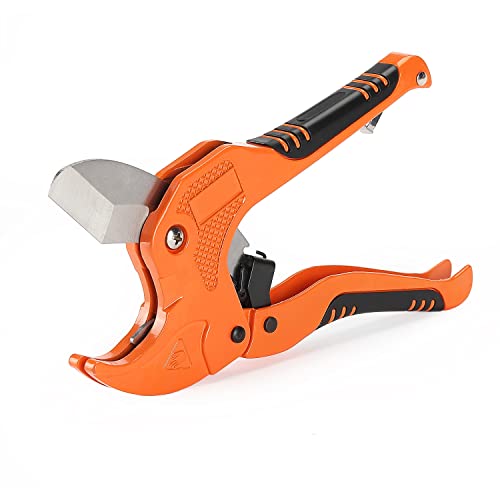
- Cuts plastic pipe up to 1-5/8 inches
- Ratchet action reduces hand effort
- Locking handle supports safe storage
Best For: PVC, PEX, CPVC, PE, and rubber hose
Best Close-Quarters Pick
RIDGID Model 104 Tubing Cutter

- Cuts tubing from 3/16 to 15/16 inch
- Works in restricted spaces
- Handles copper, aluminum, brass, and plastic
Best For: Small-diameter tubing work in tight spaces
Best PVC Ratcheting Pick
Klein Tools Ratcheting PVC Pipe Cutter

- Cuts pipe up to 1-1/4 inches
- Works with PVC, CPVC, and PEX
- Soft-molded handles provide grip
Best For: Small plastic plumbing installations and repairs
Best Powered Copper Pick
Milwaukee M12 Cordless Pipe Cutter

- Cuts 3/8- to 1-inch copper pipe
- Runs at up to 500 RPM
- Uses Milwaukee M12 batteries
Best For: Fast copper cutting in low-clearance spaces
Heavy-Duty Steel Pick
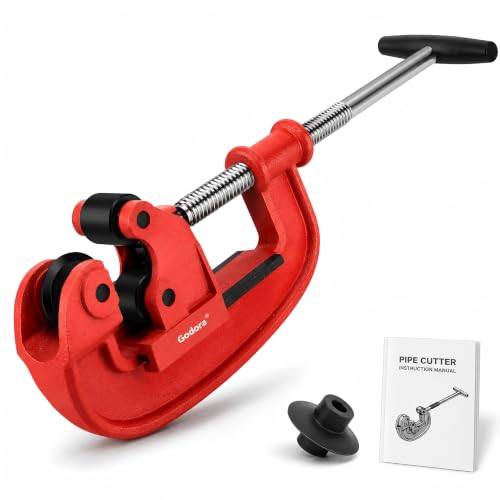
- Cuts 1–3 inch iron and steel pipe
- Smooth ball-bearing feed
- Includes an extra cutting wheel
Best For: Large-diameter iron and steel pipe work
Precision Tubing Pick
Klein 50077 Quick-Adjust Cutter

- Cuts aluminum and copper tubing to 1 inch
- Quick-adjust screw-feed design
- Includes deburring blade and tank key
Best For: Compact tubing work and service calls
Best Simple Pick
2–4-3/4 Inch Plastic Pipe Cutter

- Cuts 2–4-3/4 inch plastic pipe
- Works with ABS, PVC, PPR, and PE
- Quick-release lever speeds setup
Best For: Large plastic pipe cutting jobs
Best Compact Pick – RIDGID Model 101 Close Quarters Cutter
For shoppers comparing pipe cutters under 500, the RIDGID Model 101 is a compact manual option built for tight spaces. It cuts 1/4-inch to 1-1/8-inch tubing and works with copper, aluminum, brass, and plastic.
Best For: Close-quarters plumbing work and small-diameter metal tubing.
Pros:
- Compact design for restricted spaces.
- Handles several metal types plus plastic.
- Includes a spare cutter wheel.
- Knurled feed screw supports controlled cutting pressure.
Cons:
- Its 1/4-inch to 1-1/8-inch capacity is narrower than larger cutters.
- Manual cutting requires repeated turning.
The lightweight steel housing and compact format make this a practical choice when access matters more than maximum capacity.
Best Wide-Range Option – Heavy-Duty 2-Inch Pipe Cutter
Among pipe cutters under 500, this heavy-duty model stands out for its broad 3/16-inch to 2-inch outside-diameter range. Its aluminum-alloy body, six ball-bearing rollers, and included deburring tool suit a variety of metal-tubing tasks.
Best For: Cutting copper, aluminum, stainless steel, and other metal tubing across a wide size range.
Pros:
- Accommodates tubing from 3/16 inch to 2 inches.
- Six rollers help stabilize the pipe during cutting.
- Includes an inside-and-outside deburring tool.
- Lightweight aluminum-alloy construction.
Cons:
- Small burrs can still occur and require reaming.
- Designed for metal tubing rather than general plastic-pipe cutting.
This is a versatile choice for users who need one cutter to cover multiple metal-tube sizes and want deburring capability included.
Best Premium Tubing Design – RIDGID Model 150 Cutter
RIDGID 31622 Model 150 Constant Swing Tubing Cutter, 1/8-Inch to 1-1/8-Inch Tube Cutter
Check Price On AmazonIf you are comparing pipe cutters under 500 for regular tubing work, the RIDGID Model 150 combines a 1/8-inch to 1-1/8-inch range with features aimed at smoother operation. It cuts copper, brass, aluminum, and thin-wall conduit.
Best For: Frequent tubing cuts where easy adjustment, reaming, and cutter-wheel replacement are useful.
Pros:
- Enclosed feed screw helps resist clogging and jamming.
- Ergonomic X-CEL knob provides a firmer grip.
- Tool-free cutter-wheel changes with the ball-detent pin.
- Includes a fold-away reamer and spare wheel.
Cons:
- Maximum capacity is limited to 1-1/8 inches.
- Intended for tubing and thin-wall conduit, not large pipe.
The enclosed mechanism and quick wheel-change system make this a well-equipped option for users who value convenience during repeated tubing jobs.
Best Plastic-Pipe Pick – Bates Ratchet PVC Cutter
For pipe cutters under 500 focused on plastic, the Bates ratchet cutter offers a straightforward way to cut pipe and tubing up to 1-5/8 inches. Its manganese-steel blade, ratchet action, and textured handle are designed for controlled hand use.
Best For: PVC, CPVC, PEX, PE, PP, rubber hose, and multilayer tubing.
Pros:
- Ratchet mechanism helps make cuts with a few presses.
- Works with several plastic pipes and flexible tubing types.
- Textured handle supports a secure grip.
- Locking buckle helps with storage and safety.
Cons:
- Not suitable for metal pipes.
- Not suitable for 2-inch PVC.
- Maximum listed capacity is 1-5/8 inches.
This is a practical plastic-pipe specialist, but shoppers working with metal or larger PVC should choose a different cutter type and size.
Best Close-Quarters Pick – RIDGID Model 104 Tubing Cutter
RIDGID 32985 Model 104 Close Quarters Tubing Cutter, 3/16-inch to 15/16-inch Tube Cutter
Check Price On AmazonFor shoppers comparing pipe cutters under 500, the RIDGID Model 104 is a compact manual option for small-diameter tubing. Its 3/16-inch to 15/16-inch capacity and close-quarters design make it especially practical where working space is limited.
Best For: Cutting small copper, aluminum, brass, and plastic tubing in restricted spaces.
Pros:
- Designed specifically for tight or restricted work areas.
- Cuts hard and soft copper, aluminum, brass, and plastic tubing.
- Large knurled feed screw helps control cutting pressure.
- Lightweight 5.3-ounce construction with a stated lifetime defect warranty.
Cons:
- Its 3/16-inch to 15/16-inch capacity is limited to smaller tubing.
- Manual operation requires hand-applied cutting pressure.
The RIDGID Model 104 is a focused choice rather than an all-purpose cutter. Choose it when compact access, light weight, and compatibility with several small tubing materials matter most.
Best PVC Ratcheting Pick – Klein Tools Ratcheting PVC Pipe Cutter
Among pipe cutters under 500, the Klein Tools 50063 stands out as a hand-powered option for common plastic plumbing materials. Its ratcheting mechanism cuts pipes up to 1-1/4 inches and is designed for schedule 40/80 PVC, CPVC, and PEX.
Best For: Cutting plastic plumbing pipe up to 1-1/4 inches with a comfortable, secure grip.
Pros:
- Ratcheting design cuts up to 1-1/4-inch pipe.
- Compatible with schedule 40/80 PVC, CPVC, and PEX.
- Soft-molded handles support comfort and grip.
- Latch keeps the cutter securely closed during storage.
Cons:
- Intended for listed plastic pipe materials rather than metal tubing.
- Limited to pipe sizes up to 1-1/4 inches.
This Klein cutter is a practical match for routine PVC, CPVC, and PEX work. Its ratcheting action and storage latch add convenience, while the defined capacity keeps it best suited to smaller plastic pipe.
Best Powered Copper Pick – Milwaukee M12 Cordless Pipe Cutter
For buyers searching pipe cutters under 500, the Milwaukee 2471-20 offers powered cutting for type K, L, and M copper pipe. It automatically adjusts from 3/8 inch to 1 inch, reaches up to 500 RPM, and is supplied as a power tool only without a battery.
Best For: Faster copper pipe cutting in low-clearance plumbing applications.
Pros:
- Automatically adjusts across 3/8-inch to 1-inch copper pipe.
- Up to 500 RPM can provide faster cutting than manual cutters.
- Sealed head is designed to resist water intrusion.
- Works with Milwaukee M12 RED LITHIUM batteries.
Cons:
- Battery is not included; this is a power-tool-only listing.
- Designed for type K, L, and M copper pipe rather than multiple pipe materials.
- Its cutting range tops out at 1 inch.
The Milwaukee 2471-20 makes the most sense for users already invested in the M12 battery platform or those prioritizing speed. Its 1-1/2-inch low-clearance specification is useful near walls, but the narrower copper-focused application should guide your choice.
Heavy-Duty Steel Pick – 1–3 Inch Pipe Cutter
If you need pipe cutters under 500 for larger iron or steel pipe, this heavy-duty model covers 1- to 3-inch outside diameters. Its long handle and ball-bearing feed are aimed at controlled, efficient cutting rather than compact portability.
Best For: Plumbers, metalworkers, construction work, automotive repair, and heating repair involving iron or steel pipe.
Pros:
- Handles 1- to 3-inch iron and steel pipes.
- Ball-bearing feed supports smooth, accurate rotation.
- Alloy steel wheel is designed for flat, burr-free cuts.
- Includes an extra cutting wheel for added service life.
Cons:
- Not suitable for copper or aluminum pipe.
- At 6.25 pounds and 15 inches long, it is less convenient for tight spaces or portable kits.
This is a capable choice when diameter range and leverage matter more than low weight. Confirm that your work involves iron or steel before buying.
Precision Tubing Pick – Klein 50077 Quick-Adjust Cutter
Among pipe cutters under 500, the Klein Tools 50077 stands out for compact handling and fast size adjustment. It is designed for aluminum and copper tubing up to 1 inch, with a fixed wheel and integrated deburring features for controlled finishing.
Best For: Plumbers and technicians cutting smaller aluminum or copper tubing and wanting an integrated tank key.
Pros:
- Cuts aluminum and copper tubing up to 1 inch.
- Quick-adjust button and contoured knob speed setup.
- Fixed wheel helps reduce tube walking during cuts.
- Built-in beveled blade deburs specified pipe sizes, and the body includes a tank key.
Cons:
- Its cutting capacity is limited to tubing up to 1 inch.
- Designed for aluminum and copper tubing rather than larger iron or steel pipe.
Choose this model for smaller tubing jobs where adjustment speed, precise control, and built-in convenience features are useful. Its compact 10.1-ounce design also suits portable tool storage.
Best Simple Pick – 2–4-3/4 Inch Plastic Pipe Cutter
Pipe Tubing Cutter Tool 2" to 4-3/4" Outer Diameter for Cutting PVC PPR PE Pipe Tubes
Check Price On AmazonFor shoppers comparing pipe cutters under 500 for plastic pipe, this tool covers a broad 2- to 4-3/4-inch outside-diameter range. It is made for ABS, PVC, PPR, and PE tubes, with a release lever and sliding wheel intended to speed setup.
Best For: Cutting larger plastic plumbing and tubing, including ABS, PVC, PPR, and PE pipe.
Pros:
- Supports plastic pipe from 2 to 4-3/4 inches outside diameter.
- Works with several common plastic pipe materials.
- Fast-acting release lever opens the cutter to its maximum size.
- Bearing-steel cutting wheel is built for high hardness.
Cons:
- Not specified for copper, aluminum, iron, or steel pipe.
- At 3.44 pounds and 16.25 inches long, it is larger than a compact tubing cutter.
This model makes the most sense when your priority is cutting larger plastic pipe quickly. Verify the pipe material and outside diameter before selecting it for a project.
How We Picked the Best Pipe Cutters Under 500
We selected tools across the main pipe-cutting categories rather than treating every model as interchangeable. The lineup includes compact close-quarters cutters for installed tubing, screw-feed and constant-swing designs for general maintenance, ratcheting cutters for PVC, a cordless copper cutter for faster repetitive work, and larger tools for steel or oversized plastic pipe.
Our comparison emphasizes stated cutting capacity, material suitability, adjustment style, portability, and practical use. A tool’s maximum diameter is important, but so is its minimum capacity and whether its design can work in a confined space.
Quick Comparison
| Best For | Recommended Type | What to Prioritize |
|---|---|---|
| Copper and small tubing | Close-quarters or screw-feed cutter | Low minimum diameter and compact profile |
| PVC and plastic pipe | Ratchet pipe cutter | Cutting capacity, sharp replaceable blade, comfortable handles |
| Frequent copper cuts | Cordless powered cutter | Speed, battery platform, access around the pipe |
| Steel pipe | Heavy-duty wheel cutter | Rigid construction, cutting range, spare wheel availability |
| Large PVC, PPR, or PE | Oversized pipe cutter | Outer-diameter range and stable adjustment |
Key Buying Factors for Pipe Cutters Under 500
Material and Cutting Capacity
Confirm that the cutter is designed for your pipe material. Copper and thin-wall tubing generally require a different wheel and mechanism than steel. PVC, PPR, and PE are often better suited to ratcheting blades, while large or rigid pipe may require a heavier frame. Check both the minimum and maximum outside diameter, not just a nominal pipe-size label.
Access and Adjustment
Close-quarters cutters are valuable when a pipe is installed near a wall, fitting, or other obstruction. Screw-feed models offer controlled adjustment and are useful where precision matters. Ratcheting designs can be easier to operate in repeated cuts, but they need enough handle movement and may not fit in tight spaces.
Cut Quality and Follow-Up Work
A clean, square cut reduces deburring and makes fitting or joining easier. Look for a reaming or deburring feature when working with metal tubing. For plastic pipe, prioritize a blade that produces minimal crushing or distortion and can be replaced when dull.
Manual Versus Powered Operation
Manual cutters are simple, quiet, and dependable for occasional work. Powered models can save time on repetitive copper cuts, but remember to account for battery, charger, noise, and maintenance costs. A powered tool is most useful when its speed outweighs the simplicity of a manual cutter.
Who Should Buy Which Pipe Cutters Under 500?
Choose a compact close-quarters model for plumbing repairs where access is restricted. Select a general-purpose screw-feed or constant-swing tubing cutter for mixed copper and small-tube maintenance. For home improvement projects involving PVC, a ratcheting cutter is typically faster and easier than a wheel-style metal cutter.
Professionals making frequent copper cuts may benefit from the cordless option, especially if they already use the same battery platform. For steel pipe, choose the heavy-duty cutter with a suitable diameter range and a spare blade. If your work involves large PVC, PPR, or PE pipe, use the oversized cutter rather than forcing a small tool beyond its rated capacity.