Hidden moisture can damage drywall, flooring, framing, and furniture long before stains or mold become obvious. The right moisture meter helps homeowners check suspicious areas, investigate leaks, and monitor drying after repairs.
These 10 picks include pin-style, pinless, and combination meters for common household materials. Use the guide below to choose the sensing method, measurement range, and features that best fit your projects.
Best 10 Moisture Meters for Homeowners Picks for 2026
Best Overall for Versatile Home Checks

- Pin-type testing for wood and building materials
- Backlit display with audible moisture alerts
- Includes extra pins, battery, and calibration-check cap
Best For: Routine leak, wall, wood, and dampness checks
Best Budget Pin-Type Option
RDINSCOS Replaceable Pins Meter

- Direct pin measurements inside materials
- Useful for walls and firewood
- Compact design with included AAA batteries
Best For: Basic household moisture and firewood checks
Best Non-Destructive Home Tester
Kiprim WM01 Pinless Moisture Tester

- Pinless scanning protects finished surfaces
- Four modes cover wood, walls, and masonry
- Reads up to 40mm deep with data hold
Best For: Non-destructive checks on wood, floors, walls, and masonry
Best for Building-Material Scanning
Klein Tools ET140 Pinless Meter

- Non-destructive EMF scanning up to 3/4 inch
- Works on four specified material types
- Reverse-contrast display and nine LED bars
Best For: Leak and flooding checks on walls, wood, and masonry
Non-Destructive Scanner
RDINSCOS Rechargeable Pinless Meter
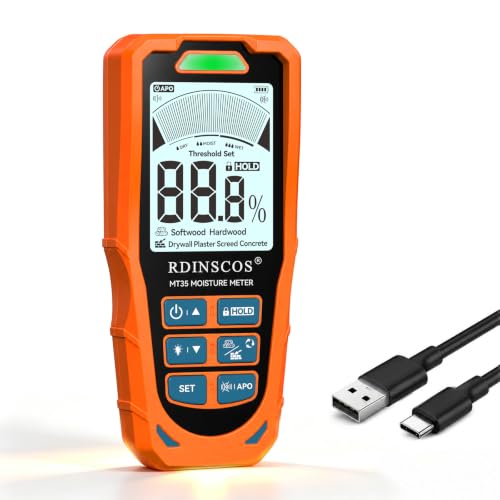
- Scans up to 19 mm without surface damage
- Six modes for wood and building materials
- Rechargeable battery lasts up to eight hours
Best For: Screening walls, floors, and renovation areas
Easy-Read Home Tester

- Large LCD with bar graph and percentage display
- Tri-color backlight signals moisture level
- Seven calibration scales for wood and building materials
Best For: Clear, routine checks of firewood, drywall, and renovation areas
Best for Area Scans
LASELION MS04 Pinless Moisture Meter

- Ball probe scans broad areas and corners
- Non-destructive readings protect finished surfaces
- Adjustable MID and WET moisture alarms
Best For: Homeowners checking walls, floors, ceilings, and finished wood
Best for Multi-Material Checks

- Four modes cover wood, walls, and masonry
- Color LCD provides visual and audible alerts
- Hold function and auto shutoff simplify use
Best For: Homeowners inspecting lumber, drywall, concrete, and masonry
Best Dual-Mode Option
LASELION MS03 Pin & Pinless Meter

- Switches between pin and pinless testing
- Covers wood, drywall, concrete, and plaster
- Includes flashlight, hold, and temperature display
Best For: Homeowners needing both surface scans and targeted readings
Best Overall for Versatile Home Checks – General Tools MMD4E
For homeowners comparing moisture meters for homeowners, the General Tools MMD4E is a versatile pin-type option for checking wood, drywall, concrete, and other building materials. It offers clear readings, audible moisture levels, and useful accessories for routine leak and dampness checks.
Best For: Homeowners who want one meter for wood, walls, suspected leaks, and mold-prevention checks.
Pros:
- Measures wood from 5–50% and building materials from 1.5–33%.
- Uses large backlit digits, on-screen icons, and low, medium, and high moisture tones.
- Includes extra stainless-steel pins, a protective cap that doubles as a calibration checker, and a 9V battery.
Cons:
- Pin testing requires inserting stainless-steel pins into the material.
- The listed operating temperature range is 32°F to 60°C, with temperature-reading accuracy of ±2°F.
The MMD4E is a practical all-around choice when you need direct readings across several household materials and appreciate visual and audible alerts.
Best Budget Pin-Type Option – RDINSCOS Replaceable Pins Meter
The RDINSCOS Replaceable Pins Moisture Meter is a straightforward choice for homeowners comparing moisture meters for homeowners. Its contact pins measure inside wood and building materials, making it useful for checking questionable walls after leaks and testing firewood before burning.
Best For: Homeowners who want a simple pin meter for drywall concerns, repair decisions, and firewood checks.
Pros:
- Pin-type testing provides direct measurements inside wood and building materials.
- Replaceable pins support continued use over time.
- Compact 7.7-ounce design and included three AAA batteries make it convenient to keep on hand.
Cons:
- Pin testing can leave small insertion points in the tested surface.
- Very dry wood may display 0%, so readings should be taken with full pin contact and sufficient depth.
With its focused feature set and practical guidance for wall and firewood testing, this model suits basic household moisture decisions without unnecessary complexity.
Best Non-Destructive Home Tester – Kiprim WM01 Pinless Moisture Tester
For homeowners seeking non-destructive moisture meters for homeowners, the Kiprim WM01 scans surfaces without pin holes and offers separate modes for softwood, hardwood, walls, and masonry. Its hold function, alerts, and carrying pouch make it convenient for repeated household checks.
Best For: Homeowners who prefer surface scanning for wood, floors, walls, and masonry and need readings up to 40mm deep.
Pros:
- Pinless testing avoids damaging the surface.
- Four measurement modes help accommodate softwood, hardwood, walls, and masonry.
- Offers one-key data hold, audible alerts with mute, a pouch, and an included 9V battery.
Cons:
- Metal, pipes, and wiring behind a surface can interfere with readings.
- The notes caution that drywall and other low-density materials may produce inconsistent or inaccurate measurements.
- It is described as suitable for home use rather than as a professional-grade instrument.
The WM01 is appealing when protecting finished surfaces matters, but its material limitations mean homeowners should follow the testing guidance carefully, especially on drywall.
Best for Building-Material Scanning – Klein Tools ET140 Pinless Meter
The Klein Tools ET140 is a pinless option for homeowners comparing moisture meters for homeowners and needing non-destructive checks after leaks or flooding. Electromagnetic-field technology scans up to 3/4 inch deep, while the reverse-contrast display and LED bar graph make the moisture range easy to read.
Best For: Homeowners checking drywall, masonry, hardwood, and softwood without puncturing the surface.
Pros:
- Pinless EMF detection measures up to 3/4 inch deep.
- Calibrated for drywall, masonry, hardwood, and softwood.
- Includes a reverse-contrast display, nine LED moisture bars, hold, audible alert, auto-power-off, and 2-meter drop protection.
Cons:
- It is calibrated only for the four listed material types.
- Pinless readings can be affected by conditions behind the surface, so the meter is best used within its stated applications.
The ET140 combines a durable design with easy-to-interpret visual feedback, making it a strong fit for routine building-material checks where surface damage is undesirable.
Versatile Pin-Type Pick – PREXISO 7-in-1 Moisture Meter
For homeowners comparing moisture meters for homeowners, the PREXISO stands out as a versatile pin-type option for checking wood, walls, drywall, flooring, and other building materials. Its seven calibration scales and multiple measurement modes make it useful when you want more than a basic dampness reading.
Best For: Homeowners, woodworkers, flooring projects, and checking possible moisture in walls or building materials.
Pros:
- Pin-based readings penetrate the test surface for direct measurements.
- Seven calibration scales cover softwood, hardwood, and building materials from 0% to 57% moisture content.
- Includes single-point, average, maximum, and minimum measurement modes, plus temperature and humidity readings.
- Color backlit LCD, hold function, probe cover, rubber grips, and automatic shutoff support convenient use.
Cons:
- Pin testing requires inserting the probes into the material.
- Its broad feature set may be more than needed for occasional single-material checks.
The PREXISO is a strong all-around choice if you need one meter for both woodworking and household moisture checks. Choose it when measurement flexibility and material coverage matter more than non-destructive scanning.
Non-Destructive Scanner – RDINSCOS Rechargeable Pinless Meter
Among moisture meters for homeowners, the RDINSCOS is a convenient choice for screening walls, floors, and other surfaces without leaving probe holes. Its pinless design scans up to 19 mm deep and uses visual and audible alerts to help identify areas that may need closer attention.
Best For: Home inspection, drywall and flooring checks, renovation preparation, and locating higher-moisture areas without surface damage.
Pros:
- Pinless detection avoids drilling or puncturing walls, floors, wood, and building materials.
- Six modes cover softwood, hardwood, drywall, plaster, screed, and concrete.
- Adjustable thresholds, LED indicators, and a buzzer help flag dry, damp, or high-risk readings.
- Large backlit screen and rechargeable 1200mAh battery provide up to eight hours of use.
Cons:
- It reports relative moisture values for screening rather than a stated percentage moisture-content range.
- Pinless readings may be less suitable when you specifically need a direct probe measurement.
The RDINSCOS is especially practical for quickly comparing multiple spots during repairs or renovations. Its non-destructive operation and customizable alerts make it a homeowner-friendly first-pass screening tool.
Easy-Read Home Tester – TopTes TS-630 Moisture Meter
For homeowners seeking moisture meters for homeowners that are straightforward to read, the TopTes TS-630 combines a large LCD with a color-coded backlight. It uses pin-type testing for firewood and drywall, while its bar graph, percentage display, and hold function make readings easy to review.
Best For: Firewood checks, drywall screening, water-damage restoration, and home renovation tasks where clear visual feedback is helpful.
Pros:
- Large 2.25-inch LCD displays moisture readings with a bar graph and percentage.
- Green, orange, and red backlighting quickly indicates low, medium, or high moisture.
- Seven calibration scales and two material modes cover wood and building materials from 0% to 57%.
- Includes three AAA batteries, a pouch, replacement pins, and a three-year warranty.
Cons:
- Pin-type testing requires inserting stainless steel pins into the surface.
- It operates on AAA batteries rather than a rechargeable battery.
The TS-630 is a sensible pick when usability is the priority. Its simple color signals and large display make it accessible for routine household checks, while the included accessories add convenience.
Best for Area Scans – LASELION MS04 Pinless Moisture Meter
For homeowners comparing moisture meters for homeowners, the LASELION MS04 is a practical choice for checking finished wood, drywall, walls, floors, and ceilings without puncturing the surface. Its ball probe scans broad areas and corners, while adjustable humidity thresholds can help flag readings that need attention.
Best For: Non-destructive area scans, leak checks, and finished surfaces.
Pros:
- Ball-shaped probe helps scan larger areas and hard-to-reach corners.
- Pinless design avoids punctures and scratches on wood, drywall, and delicate surfaces.
- Measures moisture at depths from 5–40 mm for surface and subsurface checks.
- Customizable MID and WET alarms provide moisture alerts.
Cons:
- Pinless-only operation does not provide the more targeted pin readings of a dual-mode meter.
- The product listing gives no stated measurement accuracy.
The MS04 stands out when protecting finished surfaces matters more than pinpoint probing. Its broad scanning design, alarm thresholds, flashlight, and carrying case make it well suited to routine homeowner inspections.
Best for Multi-Material Checks – Povlen MT510-Y Pinless Meter
The Povlen MT510-Y is a versatile option for homeowners comparing moisture meters for homeowners across wood and building materials. Its four scanning modes, color LCD, hold function, and audible and visual alerts make routine checks of lumber, drywall, masonry, and walls straightforward.
Best For: Multi-material inspections involving wood, drywall, concrete, cement, and masonry.
Pros:
- Offers Softwood, Hardwood, Wall, and Masonry measurement modes.
- Pinless sensing helps prevent pinholes and scratches.
- Large color LCD includes an analog bar, beeps, and turns red when readings exceed the setting.
- Hold function, auto power off, and low-battery indicator support convenient use.
Cons:
- Listed measurement accuracy is ±4%, so it is intended for detection rather than laboratory-level measurement.
- It uses three AAA batteries and does not include a pin mode for localized probing.
With dedicated modes for both wood and masonry-related materials, this meter is a strong general-purpose pick. The non-invasive design and clear alert system are especially useful for homeowners screening walls before moisture becomes a larger problem.
Best Dual-Mode Option – LASELION MS03 Pin & Pinless Meter
For homeowners who want flexibility, the LASELION MS03 combines pin and pinless testing in one of the more versatile moisture meters for homeowners. Use pinless mode on delicate surfaces such as furniture and antique wood, or switch to pins for more targeted readings in thicker lumber, drywall, and wood panels.
Best For: Homeowners who need both non-destructive scanning and targeted pin measurements.
Pros:
- Dual pin and pinless modes support different inspection needs.
- Works with wood, drywall, plaster, concrete, cardboard, and other building materials.
- Measures 0–75% in wood and 0–25% in building materials with listed accuracy of ±4%RH.
- Includes a flashlight, hold function, temperature display, and manual pinless calibration.
Cons:
- Pin mode can leave small probe marks on surfaces.
- The supplied notes do not specify included batteries or a carrying case.
The MS03 is the most adaptable choice in this group because it can scan without damage and then provide a more localized pin measurement when needed. Its broad material coverage and built-in flashlight add useful versatility for home maintenance tasks.
How We Picked the Best Moisture Meters for Homeowners
We focused on practical capabilities for household inspections rather than professional laboratory testing. The selected meters cover the main formats homeowners encounter: pin meters for targeted readings, pinless meters for scanning surfaces without punctures, and combination models that offer both approaches.
We also considered material compatibility, detection depth, display readability, portability, replaceable or rechargeable power options, and useful features such as alarms, backlighting, multiple measurement modes, and area-scanning probes. Because moisture readings vary by material and conditions, versatility and clear operation mattered as much as headline accuracy claims.
Quick Comparison
| Meter type | Best use | Main advantage | Trade-off |
|---|---|---|---|
| Pin | Spot-checking wood, drywall, and targeted areas | Direct readings and often strong penetration | Leaves small holes and requires surface contact |
| Pinless | Scanning walls, floors, and finished surfaces | Non-destructive coverage of larger areas | Can be affected by surface thickness, density, or nearby metal |
| Pin and pinless | General home inspection and follow-up testing | Combines broad scanning with targeted confirmation | Usually costs more and has more controls to learn |
Key Buying Factors for Moisture Meters for Homeowners
Pin or Pinless Sensing
Choose a pinless meter when you need to scan painted walls, flooring, cabinetry, or other finished surfaces without making holes. Pin meters are useful when you need a focused reading at a specific point or want to compare moisture at different depths. A combination meter is the most flexible choice for recurring repair and maintenance work.
Material Modes and Measurement Range
Look for modes that match your likely materials, such as wood, drywall, concrete, or masonry. A meter designed primarily for lumber may not interpret a wall or slab the same way. Check the stated moisture range and whether the device reports relative readings, percentages, or an alert threshold.
Detection Depth and Interference
Deeper sensing can help locate moisture beneath a surface, but pinless readings are influenced by material density, thickness, fasteners, wiring, and the shape of the sensor. Use readings comparatively—scan a known-dry area first, then investigate unusual changes.
Display and Everyday Usability
A large backlit screen, audible or visual alerts, automatic shutoff, and simple controls make a meter easier to use in basements, crawl spaces, and dim utility areas. Consider whether you prefer replaceable batteries or a rechargeable design.
Who Should Buy Which Moisture Meters for Homeowners?
For Occasional Leak Checks
A straightforward pinless meter is usually the easiest starting point for checking walls, floors, and ceilings without cosmetic damage.
For Woodworking and Lumber Projects
Choose a pin meter with a wood mode when you need localized readings in boards, trim, framing, or firewood. Replaceable pins are useful for long-term ownership.
For Renovations and Broader Inspections
A combination pin-and-pinless model provides the best coverage. Scan large areas first, then use pins to verify suspicious spots or compare readings around a suspected leak.
For Drywall and Finished Surfaces
Prioritize non-destructive scanning, a readable display, and a suitable detection depth. Remember that a moisture meter indicates abnormal moisture; it does not identify the leak source or replace professional testing when structural damage or mold is suspected.